


I’d never given much thought to ABBA, but as a Vietnamese American who grew up in the ’80s, I’ve become increasingly curious about how the Swedish pop group intersects with the Viet experience.
My introduction to ABBA came through Erasure, a British synth-pop duo who had won me over by embracing visual dad jokes. During the chorus of their 1988 music video for “A Little Respect,” composer Vince Clarke hands vocalist Andy Bell a tiny printout of the word “RESPECT.” (What? I was a kid and highly susceptible to punning.) By 1992, I was listening to their songs “Take a Chance on Me,” “Voulez-Vous” and “Lay All Your Love on Me,” completely unaware at the time that these were ABBA covers.
Today, Sabrina Carpenter is responsible for introducing a new generation to the catchy, uptempo stylings of ABBA. Not only has she performed the group’s songs at her concerts, but Carpenter has acknowledged their influence on her own music, which can be heard in tracks like “Goodbye.”
In Vietnam, the appreciation for ABBA has been going strong since the late 1970s. Much like the Beatles in America, the ABBA discography has become part of the soundtrack of Vietnam, with older generations inculcating new ones.
“I knew about ABBA already from childhood,” content creator Chris Tran, 40, told Salon. Born and raised in Los Angeles, Tran currently lives in Vietnam. “For us in Southern California . . . who grew up around Little Saigon, you go to the Little Saigon mall, and then they were selling bootleg CDs with all the oldies. And I being an older Millennial have a lot of cousins who brought over their musical tastes from Vietnam. So they brought over The Carpenters, The Eagles and ABBA.”
Journalist Uyên Đỗ, who’s in her late 20s, was born in Vietnam and had an opposite trajectory. Her parents exposed her to older Western artists like ABBA and the Bee Gees via YouTube playlists before she went to study abroad in the U.S.
“I developed a liking of musicals, which is not very popular in Vietnam,” she said. “‘Mamma Mia!’ was on Broadway first, and then it was adapted to screenplay. So that musical and movie consists of all the hits by ABBA. And then it just occurred to me that, ‘Oh, wait, no one [here] listens to ‘Happy New Year’ and that’s the No. 1 ABBA song in Vietnam by miles.”
“Happy New Year” in Vietnam
I never even knew that ABBA had a song called “Happy New Year,” let alone that it figures into Vietnamese new year traditions. An informal survey of my Vietnamese friends and family in the United States yielded a similar lack of recognition.
“Why do we as a country love this ABBA song a lot more than the others?”
“It just doesn’t get played in America,” confirmed Tran. “I don’t think I knew about that song until I came to Vietnam. But when I heard it, I recognized ABBA and thought, ‘Oh cool, they have a new year’s song.’ And then I find out that it’s the tradition in Vietnam. It’s iconic. It’s everywhere, it’s literally in the supermarket, it’s in convenience stores, it’s on TV.”
This culture shock played out a different way with the students Tran taught English to in Vietnam.
“I used to actually ask the kids every year, ‘What’s the new year song?’ And they’re like, ‘ABBA.’ I would play ‘Auld Lang Syne’ and say, ‘This is a traditional new year song in the West.’ They’re like, ‘Yeah, that doesn’t sound fun or good.’ They don’t even believe me. They reject my expertise.”
“I’m already hearing ‘Happy New Year’ now,” said Đỗ, who spoke to me in mid-December. “New Year’s music in Vietnam is its own genre, kind of like Christmas music. You start hearing it way before the actual event – the Western New Year, Jan. 1 – and then we have [the Lunar New Year] Tết, which is a month later. So you probably hear it for a month and a half.”
In fact, the song’s ubiquity in Vietnam – playing in retail establishments, on news broadcasts and as the only English-language song on Tết playlists – is what prompted Đỗ to delve deeper into the song’s unusual popularity.
“I thought, Vietnamese people love ABBA, and America loves ABBA – everyone loves ABBA,” she said. “But why do we as a country love this ABBA song a lot more than the others? I mean, ABBA has a stellar discography, and ‘Happy New Year’ is not even in the Top 10, not even the Top 30 of their songs. But it’s just such a staple in Vietnam.”
For the love of Sweden
(Keystone-France/Gamma-Rapho via Getty Images) On the ground, a young woman during the student demonstration against the Vietnam War in Stockholm, Sweden, on April 1, 1968
“When I was doing all the research, I started questioning my own upbringing,” She said. “Why ABBA? Why do my parents love ABBA? Why do all the adults listen to ABBA? I mean, apart from these specific Western bands, they just listen to all the other regular Vietnamese artists. So I did some digging.”
As with many of the stories involving the Western influence on contemporary Vietnamese culture, the origins lay in the Vietnam War – better known as the American War or Resistance War Against America (Kháng chiến chống Mỹ) in Vietnam. During the war, Sweden was the first Western nation to recognize North Vietnam in 1969 and became a vocal ally, with a significant portion of Swedish citizens demonstrating for what they saw as Vietnamese liberation. Following the end of the war on April 30, 1975, embargoes and sanctions stymied Vietnam’s economy and access to global culture – except for Sweden.
“There was a very limited amount of information regarding the topic; such is the reality of doing journalism in Vietnam,” said Đỗ. “All the sources were actually quite informal. I just had to try to string things together. I found out that people back in those days didn’t really have a lot of options in terms of entertainment. Therefore ABBA is one of the few [bands accepted] because we as a country didn’t have a lot of hostility against the Swedes because they were advocates against the Vietnam War.”
On April 30, for the 50th anniversary of the fall of Saigon, the Embassy of Sweden of Hanoi posted the documentary “Victory Vietnam” on YouTube. Directed by Bo Öhlén, the 30-minute film includes Swedish footage of “the lively and emotional atmosphere in Stockholm on April 30, 1975 — the day Saigon was liberated, marking the end of the Vietnam War.”
A struggling, post-war Vietnam therefore embraced the Eurovision winners out of Sweden, with their bright and flashy visuals and froth-light harmonies. In December 1980, the group released their “Super Trouper” album, which included the track “Happy New Year.” How much of the lyrics were understood by the Vietnamese at the time is up for debate, although the title and upbeat sound may have contributed to its popularity as a new year’s anthem.
“‘Happy New Year’ by ABBA is indeed a very popular song in Vietnam,” intern Moa Malmström at the Embassy of Sweden in Hanoi wrote in an email reply to Salon. “It is frequently played around the New Year period and has become something of a seasonal staple. For example, it is often performed on national television during the Vietnamese Lunar New Year (Tết) celebrations.”
A tale of two Vietnamese peoples

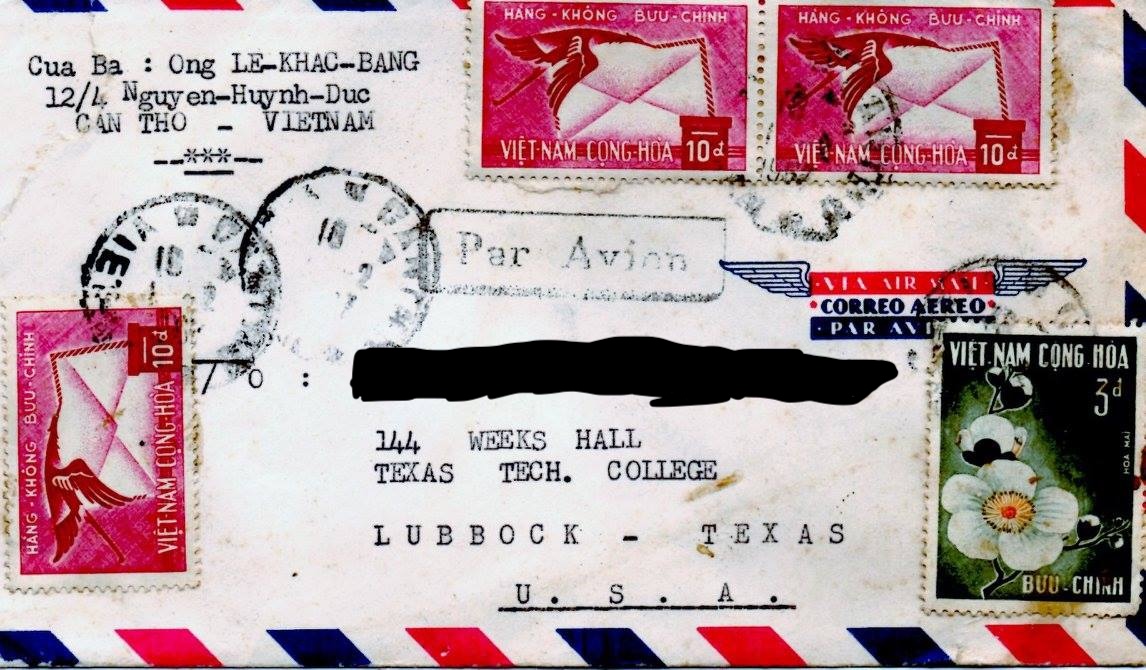
(Courtesy of Hanh Nguyen) Airmail sent to my mother when she was at university
Đỗ resides in Saigon, the country’s former Southern capital that was renamed Ho Chi Minh City after the war. Her understanding of how Western culture affected Vietnam after the war, however, had to be framed through the North and its capital, Hanoi.
“When I wrote this article, I had to focus on the perspective more of the Northerners, because they were more affected by the cultural and economic and political embargo that was placed on Vietnam at the time,” she said. “I would say that Southerners were a lot more exposed to Western culture, obviously, but for the purpose of the article. I had to focus on the Hanoian perspective, because after the war, Vietnam’s entertainment was more heavily controlled centrally from the North. So it had this ripple effect of Hanoian culture affecting Southern culture as the years went by.”
With the Northern Vietnamese influence fostering a love of ABBA because of their Swedish allies, the Southern Vietnamese – many of whom comprise the Vietnamese diaspora – can be forgiven for not necessarily following suit. My mother certainly still carries strong feelings from the war, including a hatred for Jane Fonda, aka “Hanoi Jane” after she posed for a photo on a North Vietnamese anti-artillery gun.
Besides, my mother had already established distinctly different cultural tastes due to exposure to other nations long before the war ended. In the late 1960s, she had attended a Texas university on scholarship, and during the war, she and my father had worked in Japan. After Saigon fell, they made Texas their new home.
When I texted my mother to ask if she knew about “Happy New Year” being popular in Vietnam after the war, she responded, “After 1975 we left Japan [and] went straight to the U.S. By then we were in a mourning state of mind and worried about [a] dark future, so had no connection with Vietnam for quite a while.”
Like twins separated at birth, the Vietnamese nationals’ and the Vietnamese Americans’ parallel yet separate developments can be encapsulated in various cultural artifacts. The red flag with central yellow star stayed official in the home country, while the Southern yellow flag with three red stripes became a refugee reminder in the United States. Language in Vietnam continued to evolve, while the Vietnamese my mother speaks is a time capsule from the mid-1970s. While Vietnam embraced Western artists like ABBA, Modern Talking and Boney M after the war, my mother was listening to The Beatles, a band whose concert she had attended in her university days. And when “Happy New Year” took hold in Vietnam, my family had learned “Auld Lang Syne” in the West.
A bittersweet New Year’s message
Đỗ further theorizes that the Vietnamese adopted “Happy New Year” because at the time, they were unaware of the song’s true meaning, not understanding the English lyrics. A close reading reveals that the song is, in fact, a major bummer.
Happy New Year, Happy New Year May we all have a vision now and then Of a world where every neighbor is a friend Happy New Year, Happy New Year May we all have our hopes, our will to try If we don’t, we might as well lay down and die You and I . . .
Reportedly, the working title for the song was “Daddy Don’t Get Drunk on Christmas Day,” and in recent years, some have suggested that Vietnam abandon this song because of its depressing nihilism.
Seems to me now That the dreams we had before Are all dead, nothing more Than confetti on the floor
In its defense, today the lyrics may accurately reflect how many of us feel defeated or at least exhausted by a relentlessly challenging year. With the Vietnam War 50th anniversary this year, I’ve been reflecting on my life as a Vietnamese American in Southern California, especially following the wildfires in January and the ongoing ICE raids in which numerous immigrants, including Asians, have been detained and deported.
“When I listen to ABBA’s ‘Happy New Year’ I feel this sense of nostalgia and calm and understanding.”
On the other side of the world, Tran has seen the results of ICE’s actions firsthand. In September he greeted his uncle who had been deported without any possessions to provide him with a backpack of essentials, courtesy of a grassroots mutual aid project, the Ba Lô Project. And more recently, Vietnam has been experiencing devastating floods, which mobilized Tran, who spoke to me from Haiphong during a break from his advocacy work.
“We did two months of typhoon disaster relief for five provinces here,” he said. “We raised $140,000 and just wrapped up. So I’m not home yet, and I’m exhausted, but it was good work. It was a really challenging year.”
Meanwhile, Đỗ doesn’t want to abandon “Happy New Year” either. To her, it feels more poignant than ever.
“Some people are suggesting we move away ABBA’s ‘Happy New Year’ and move toward more local Tết music,” she said. “I don’t really relate to any of these songs because Tết as a holiday in Vietnam is meant to represent prosperity and happiness. You’re expected to welcome the new year with open arms; I don’t feel that. I feel a lot of anxiety about the future, especially with how things are going climate-wise and politically.
“And so when I listen to ABBA’s ‘Happy New Year’ I feel this sense of nostalgia and calm and understanding. It’s a very sad song, obviously, but it feels comforting to know that people 45 years ago felt the same anxiety as I do now. It’s just kind of human nature.”
Whether it’s the idea that misery loves company or that everyone endures and overcomes some sort of hardship, a glimmer of hope exists in a future that is unwritten. This is even hinted at in “Happy New Year”:
It’s the end of a decade In another 10 years time Who can say what we’ll find What lies waiting down the line In the end of ’89
“I’m looking forward to 2026,” said Tran. “Here, everyone’s talking about how it’s the Year of the Snake. We’re shedding our skin, and then the next year is the year of renewal.”
Read more
about the straddling of Western and Asian culture