


Sometime last year, I noticed that animal prints seemed to be following me around online. Nothing aggressive, but there was a noticeable uptick in sponsored posts on Instagram featuring velvet tiger-print sneakers and pink leopard-print workout sets. The secondhand site where I’ve bought most of my clothing for the past decade was definitely sneaking an increasing number of wildlife prints — pastel snakeskin blouses, giraffe-print palazzo pants, a blazer printed in an unholy mashup of leopard, tiger and zebra — in among the jeans and striped t–shirts it surfaced for me. Finally, I texted my most stylish friend: “Are animal prints trendy again, or does my algorithm just think I’m old?” She texted back an hour later: “Yes.”
My longstanding appreciation for leopard, the most timeless of patterns, has existed at a remove from anything I actually own and wear. It’s not a tangible, functional marker of accumulated years in the vein of compression socks or bifocals, but a cheery abstraction tucked into the tiny drawer in my mind labeled maybe someday. Leopard print is future me — a woman of a certain age, just not my age.
I texted my most stylish friend: “Are animal prints trendy again, or does my algorithm just think I’m old?” She texted back an hour later: “Yes.”
This is, of course, very silly, because versatility and accessibility are leopard print’s whole thing, according to Jo Weldon, the headmistress of New York’s School of Burlesque and author of “Fierce: The History of Leopard Print,” who notes that leopard print hasn’t evolved so much as it has continually accumulated contexts and meanings. To mix a metaphor, leopard is a sartorial and cultural workhorse. It’s refined, but it’s punk. It’s retro but also futuristic. It’s been worn by drag queens and actual queens. It’s Sunset Boulevard, it’s Jersey Shore. It’s Jackie Kennedy and Marilyn Monroe, Josephine Baker and Bettie Page, Peg Bundy and Enid Coleslaw. It’s Little Richard and Barbra Streisand, Eartha Kitt and Shania Twain, Josie & the Pussycats and The New York Dolls.
But apparently I’m not alone in this. Scrolling discussion threads and comment sections and talking with actual people reveals a fair amount of angst out there about the intersection of aging and animal print for the middle-aged woman. As with nearly everything related to women’s appearances, the media plays an outsized role in foregrounding the anxiety. There are an astonishing number of headlines about how to dress a body that has made itself a problem by insisting on aging and carrying weight differently and no longer having breasts but instead having a bosom, and they are all variations on a theme: growing older are variations on a theme: “How to wear leopard print for women over 40,” “How to wear leopard print over 50,” “How to wear leopard print in your 60s and 70s — without feeling like Cruella DeVille.”
Delegates from the fashion industry insist that leopard, along with patterned relatives like cheetah, snow leopard and ocelot, is a neutral, and I see their point: It flatters a wide range of skin tones and hair colors, and is fabricated in equally numerous sizes from equally numerous materials. In an era where fashion is no longer dictated by a small number of editors, buyers and tastemakers, it has also become trend-proof: Leopard is no longer “in” or “out,” it simply is, all the time, everywhere. But it’s difficult to square the apparent ease and simplicity of the print with the constantly manufactured anxiety of how to wear it without looking, well, old.
(Kayla Oaddams/WireImage/Getty Images) Regina Hall attends Elle Women In Hollywood 2025 on November 17, 2025 in Los Angeles, California.
Kitten vs. cougar
Even worse than looking old in leopard print is wearing it thinking you might still pass as young. In 1967, the sleek, seductive glamour of leopard print icons like Kitt and Baker was pushed into a much less flattering light by “The Graduate” and its cautionary femme fatale, Mrs. Robinson. We’re introduced to pop culture’s defining cougar when she’s wearing a classic leopard fur, but don’t truly see her until she’s in a leopard-print bra and slip, embarrassingly predatory in her attempts to seduce Benjamin Braddock. Previously confident and decisive in her leopard fur, the leopard lingerie is understood as a cheap, sad facsimile that reveals that confidence as loneliness and desperation.
Mrs. Robinson inaugurated the cougar archetype, but perhaps more importantly, she instructed audiences to feel pity, derision and even disgust for her. The result over the following decades was that for every pop culture product that painted an even mildly approving or empowering portrait of cougardom — “Bull Durham,” “How Stella Got Her Groove Back,” “Sex and the City” — there were dozens of Mrs. Ropers and Stifler’s Moms, caricatures audiences could laugh at unreservedly. And media outlets hung figurative clocks over real-life cougars like Cher, Demi Moore, Halle Berry and Madonna, waiting with bated breath for the humiliation that awaited them when their young paramours left them.
Want more from culture than just the latest trend? The Swell highlights art made to last.Sign up here
The simmering resentment of cougars in the wild boiled over in 2010, when German researchers published a study claiming that “women who marry men either older or younger than themselves die earlier than those who marry men their own age (within one to two years).” Scrambling to get cougar jokes into the headlines as quickly as possible, the press conveniently failed to report the finding that women marrying men older than them also increased their mortality.
Not all older women in leopard print are cougars, and not all cougars wear leopard print. But the disdain visited on women, both real and fictional, who insist on remaining both visible and sexual beyond what society has deemed their sell-by dates helps explain why fundamentally harmless branded overtures on social media might come across as more hectoring than helpful: Hey, you old bag, throw on this leopard-zebra-snake caftan made from non-breathable fabric so we can all have a good laugh.
By the time we reach middle age, most women are all too familiar with the reality that clothing of any kind is generally less about what’s actually being worn than it is about who is looking. We’ve been culturally conditioned to see physical signs of aging as failures of commitment and willpower, and for every woman who, like Weldon, embraces the apex-predator swagger of the big cat, there is one who treats the wearing of an animal print — or really, as one friend clarified, any print that might be called “fun” — like waving a flag of surrender.

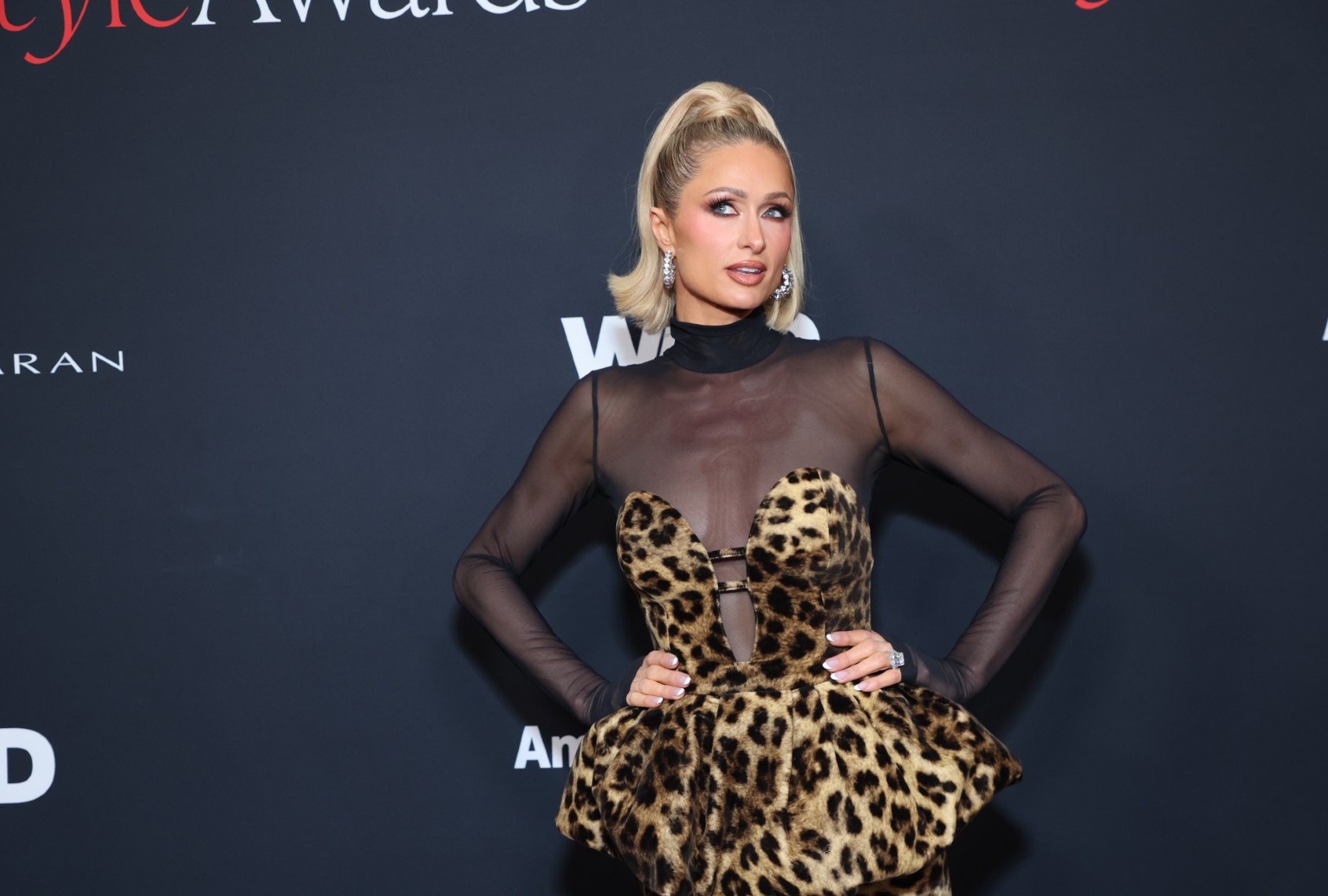
(Robin L Marshall/WireImage) Paris Hilton attends Women’s Wear Daily presents the 2026 WWD Style Awards on January 09, 2026.
Animal style
In his 2000 monograph “Chromophobia,” artist and critic David Batchelor examined the aversion to bright color that characterizes much of Western culture and intellectual thought, theorizing that a society ordered, controlled and gatekept by a homogeneous demographic of men saw bright, florid hues as interlopers into a vision of civilization as restrained and monochromatic. Marginalizing color, Batchelor wrote, depended on treating it like “the property of some ‘foreign’ body — usually the feminine, the oriental, the primitive, the infantile, the vulgar, the queer or the pathological.”
Animal prints, despite their generally neutral hues, have been similarly othered. As Weldon points out in “Fierce,” “images of leopard-clad natives and ‘wild men,’ such as Tarzan, are largely a fabrication of colonial imaginations that associated ‘primitive’ cultures with the wearing of animals.” The same dehumanizing prurience that led American and European colonizers to put Black African women on public display echoed faintly in the words of Christian Dior, who played up the savage subtext of his “New Look” leopard prints by warning that “If you are fair and sweet, don’t wear it.” Intimates brand Vanity Fair, the first to introduce leopard and cheetah-printed nightgowns, girdles and underwear sets in 1952, advertised them with anthropomorphically suggestive taglines like “Are you a Leopardess underneath?”
Not all older women in leopard print are cougars, and not all cougars wear leopard print. But the disdain visited on women who insist on remaining both visible and sexual beyond what society has deemed their sell-by dates helps explain why fundamentally harmless branded overtures on social media might come across as more hectoring than helpful.
Ari Seth Cohen, the author and photographer of the street-fashion blog Advanced Style, has talked at length about the phenomenon, experienced by many women, of transforming with age into someone newly willing to stand out and be seen. “I hear a lot of times from older women that they have felt invisible for many years and that sometimes after seeing women who express themselves fully, they have felt the permission to go there again. Society is so oppressive towards aging and especially towards women…. Sometimes when you see people who are fully living in their full blossomed selves, it kind of opens you up to expression.”
Elsewhere, though, older women regularly experience a distinctly modern form of othering in which age is ostensibly celebrated, but evidence of aging is airbrushed away, as with the 2023 Vogue cover featuring original supermodels Naomi Campbell, Cindy Crawford, Linda Evangelista and Christy Turlington. Vanessa Friedman, writing in The New York Times, called the photos “so retouched that they seem more like A.I.-generated bots than actual people”; rather than “a real embrace of a mature demographic,” she wrote, older models are treated as special guests to be applauded: “OMG! Look, how she defies age! Or OMG! So old!”
It’s even stranger when oldness itself is co-opted as a trending micro-aesthetic. “I was annoyed by the whole ‘Coastal Grandma’ thing” popularized on TikTok, a friend says. The majority of aesthetics created and boosted on the platform, she points out, center on girlishness: “Clean Girl,” or “Strawberry Girl,” or “Tomato Girl.” If social media is pushing Coastal Grandma or Grandma-core, “I’m going to need to see some actual grandmas.”
I’m happy to tell her about something even better: the subculture of Japanese senior citizens who wear animal prints, gaudy makeup and as much bright color as possible. They are the Osaka obachan; they have a mesmerizing idol group called Obachaan; they’re loud and take up space and, by all appearances, give zero consideration to the Best Ways to Wear Leopard Print over 60. If they’re taking applications, future me is in.
Read more
about the business of fashion