


There are two scenes in Jane Schoenbrun‘s “Teenage Sex and Death at Camp Miasma” that I hope will be among the first things to flash through my mind at the hour of my death, somewhere right after “oh sh*t,” and just before all of my dead pets and family members appear before me to take me back home.
In the first of these scenes, Kris Williams (Hannah Einbinder) runs through the woods at night, dressed only in a T-shirt and underwear, boobs bouncing and shoulder-length hair flowing side-to-side, in dreamy “final girl” form. Kris is a queer filmmaker taking on the task of reclaiming the slasher horror film-within-the-film, “Camp Miasma,” rebooting it for the queer community to no longer be appalled by. And she herself has, as of only recently, learned how to no longer be appalled by where her mind needs to travel in order to truly enjoy sex: villain-victim fantasies.
Lord, I’ve seen what you’ve done for others; please send me a beautiful woman who looks similar to these two characters, and please guide her to match my freak in the way that Kris and Billy match each other’s.
In the second scene that I hope to mentally revisit before it’s a wrap on principal photography for me on this mortal plane — seen at the very end of Schoenbrun’s latest film — Billy Presley (Gillian Anderson) walks hand in hand with Kris through a dreamscape of pleasure and gore as the most beautiful song I’ve ever heard in my life plays: “Satan,” by Andy Shauf. Billy is the star of the original “Camp Miasma” that Kris is rebooting, and she’s just given Kris permission to be as weird as she needs to be in order to come.
The theatrical burden of faking an orgasm because you don’t feel allowed to get into the headspace you need to be in in order to have a real one is gone. That looming first common, boring day after a few weeks of new bliss is gone. The habit of saying “I love you” with the same ease and banality as “can I have a napkin” is gone. Just two women being down for whatever it takes, for however long it lasts, encouraging each other to let go.
Lord, I’ve seen what you’ve done for others; please send me a beautiful woman who looks similar to these two characters, and please guide her to be compatible with me in the way that Kris and Billy are compatible with each other so that I, too, may have someone to hold hands with while slowly walking to the gas station in my underpants to buy snacks, covered head to toe in blood.
(MUBI) Hannah Einbinder in “Teenage Sex and Death at Camp Miasma”
Schoenbrun, who directed, wrote and produced 2021’s fantastic “We’re All Going to the World’s Fair” and then cemented their name as a visionary with the release of “I Saw the TV Glow” in 2024 — which they also wrote and directed — described the somewhat hard-to-describe “Teenage Sex and Death at Camp Miasma” to The New York Times as such: “In its simplest form, this is kind of a movie about two women matching each other’s freak.”
There’s a flame in my heart that wasn’t there before watching this movie, and that’s as great as a review can get.
Schoenbrun’s third major full-length release has received mixed reviews from professional critics and reactions from casual cinema-goers along the lines of “what the hell is this?” And you know what? I wish them all well. Whether this movie is a meta take on the problematic slasher genre, a delivery system for Hannah Einbinder to showcase that she has the best butt ever, or yet another chance for Gillian Anderson to give queer women what they want: Gillian Anderson; all I know is that when the credits rolled on this film, I walked to the parking lot with a twitterpated grin on my face, drove home listening to “Satan” on repeat, and then, once inside, immediately reactivated my Hinge profile and updated it to read: Looking for someone to share dipping sauces with — a reference to a scene in which Billy treats Kris to a feast of KFC, which I’m sure no one in my surrounding area will get. But if someone does . . . wedding bells!
Having recently gone from being a married woman to someone afraid of love and marriage, now that I’ve felt how quickly that can turn to vapor, I didn’t think I’d ever feel what this film made me feel again. There’s a flame in my heart that wasn’t there before watching this movie, and that’s as great as a review can get.

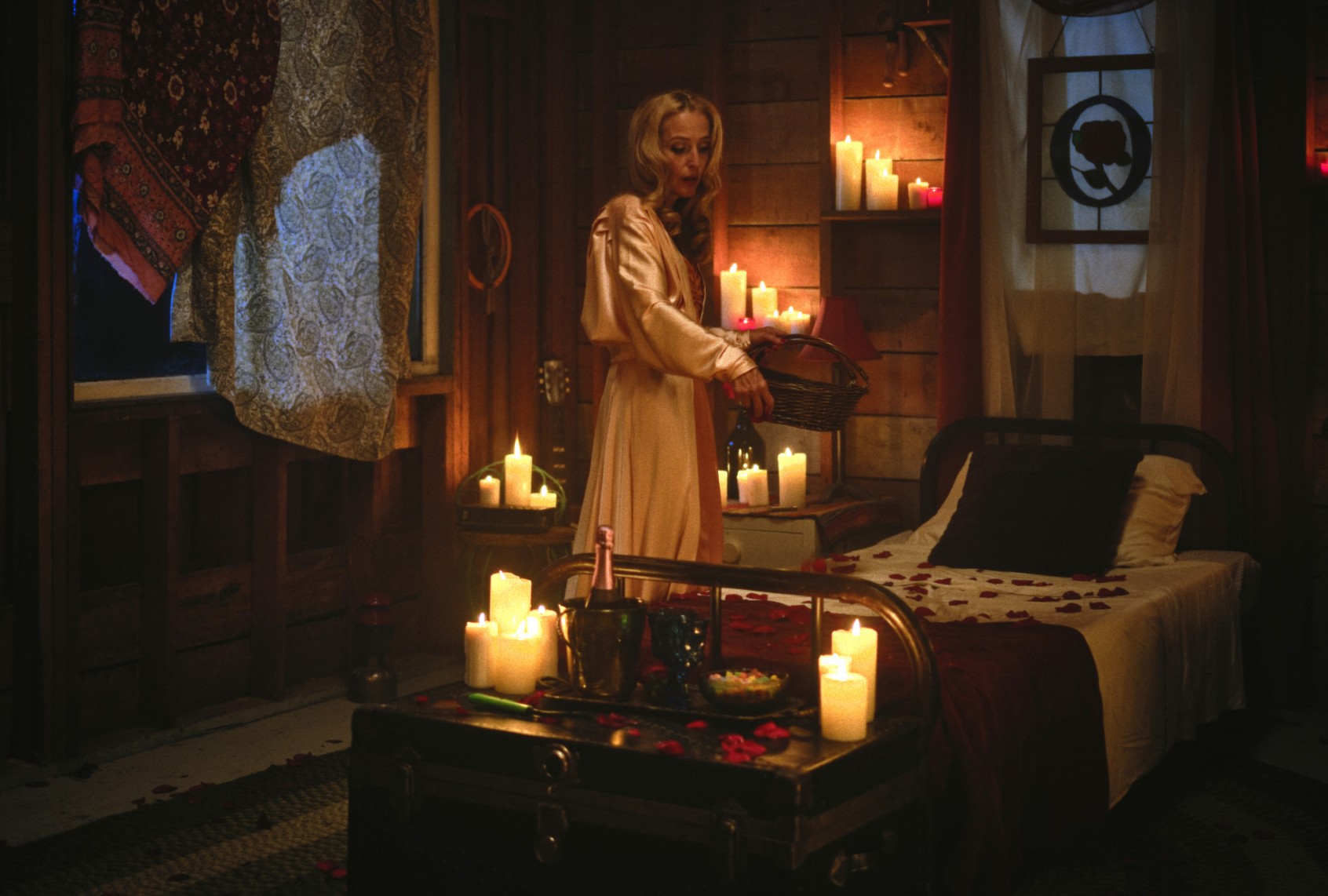
(MUBI) Gillian Anderson in “Teenage Sex and Death at Camp Miasma”
Want more from culture than just the latest trend? The Swell highlights art made to last.Sign up here
In the song “Satan,” which I will never shut up about and am acting like I personally discovered now, even though it was released as a single by Andy Shauf in 2022 and is featured on the soundtrack for “Camp Miasma” (available for pre-order now via Waxwork Records), he sings:
Don’t watch yourself, watch the movieThis only happens for a little whileBecause Satan is waitingSatan is waiting with Halloween candy
And while reading those lyrics, this may not seem like a romantic song; but in the context of the scene in which it plays, it very much is. Hearing this song after watching this movie, I felt like I was in love, even though I currently have no one to love — and didn’t think I wanted to. But the feeling was better than love, because it was just mine. Something pure. Something I could tap into just myself, or choose to share, but wasn’t attached to the memory of any of the real-life ouchy stuff.
This only happens for a little while.
As a recovering serial monogamist, maybe that “for a little while” part is a new lesson for me. Maybe that part would be OK?
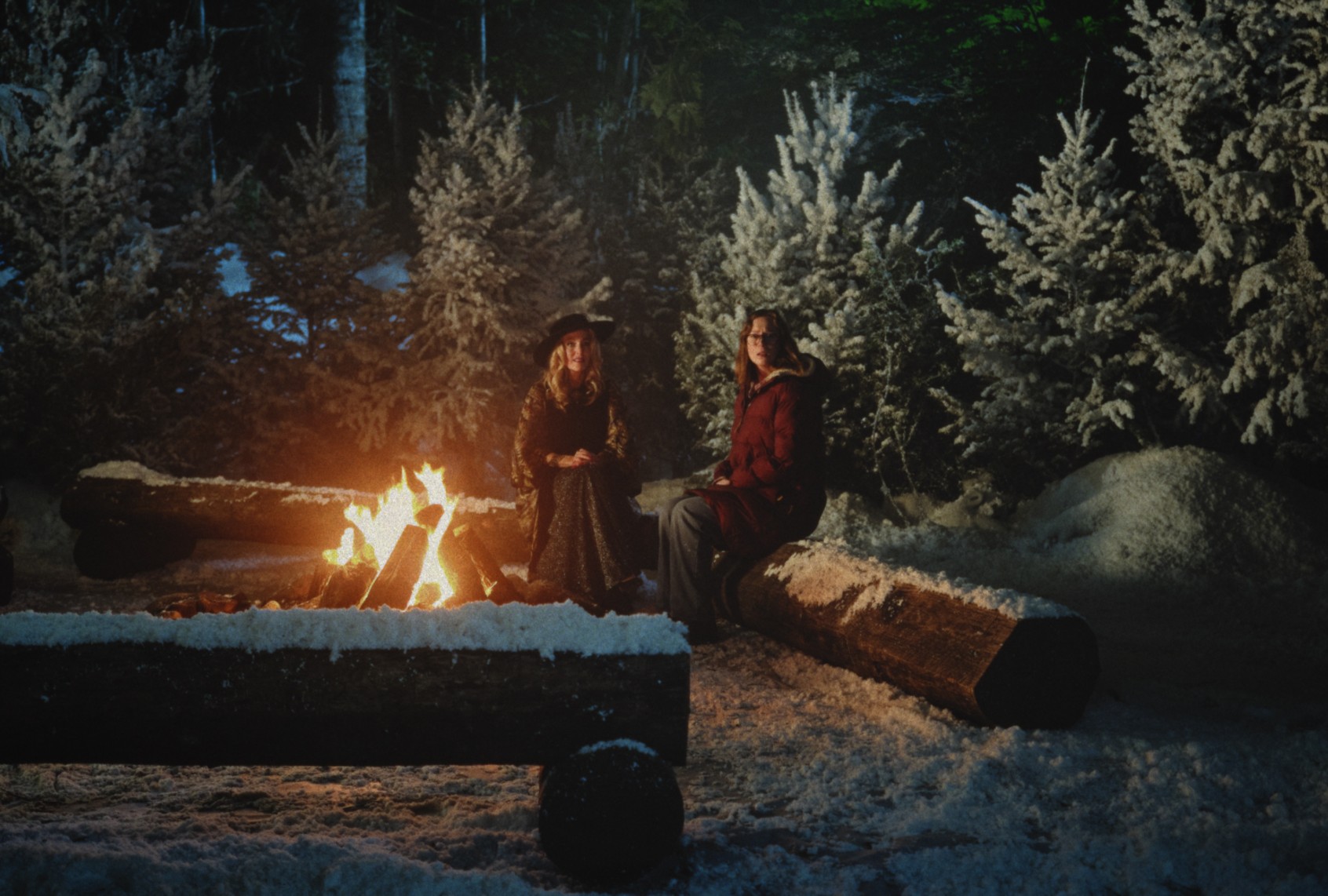
(MUBI) Gillian Anderson and Hannah Einbinder in “Teenage Sex and Death at Camp Miasma”
As a divorced lesbian who lives alone with her dog in a southern state she doesn’t feel attached to, a mix of slim-pickins and general heartache has led me to feeling like maybe I’ll just never meet the right woman for me — and working from home doesn’t make the whole situation any easier, in terms of putting myself out there, if I’d even ever wanted to.
Watching “Teenage Sex and Death at Camp Miasma” changed my tune, immediately, because it made me feel something I hadn’t felt for a long, long time: passion. And more so, the exciting possibility of passion for passion’s sake, without rushing to mold it into anything more, unless it proves itself to actually be something more, which only time can tell.
The true gift of a film like this — films in general, really — is that even though what you’re watching isn’t real, how it makes you feel is.
I will likely not encounter my very own Kris Williams or Billy Presley on a dating app. There is no Camp Miasma to autofill as my location on Hinge. But passion is waiting . . . with Halloween candy. And like Billy says to Kris in the film, “If it gets too real, you can always turn it off.” But I like the feeling of leaving it on, for now, just to see what the next scene may bring.
Read more
about this topic