


Trauma creates superheroes, we’re told. Bruce Wayne witnessed his parents’ murder and made vengeance his life’s mission. Superman survived his planet’s destruction. “Lanterns” opens with the shocking scene of John Stewart’s father, John Sr. (J. Alphonse Nicholson), aiming a gun at him and shooting an apple off his head when he was 10. Then he affectionately hugs young John (Cairo Cash Lee), who smiles up at daddy, proud he didn’t flinch.
Some origin stories present trauma as an inciting moment that changes everything. John’s, however, unfolds over the course of his childhood, when he is most impressionable, beginning on his fifth birthday. In the third episode, “OutKast,” that’s when John Sr. and his mother, Bernadette (Jasmine Cephas Jones), reveal his destiny to become the next Green Lantern. Moments after he blows out the candle on his cake, John’s father places a rifle in his hands.
Years later, once John (played as an adult by Aaron Pierre) has become one of the world’s greatest snipers, he’s placed on a top-secret mission to assassinate an international criminal on foreign soil. He parachutes in, sets up a shelter in the woods near his target’s home and waits for his shot. For nine months.
That remarkable level of discipline should have gotten John a commendation. Instead, because of a painful instance of history repeating itself, the mission concludes with his dishonorable discharge.
Pierre’s John Stewart is a satisfying retrofit of a hero originally conceived by his white comic book creators as a righteously stern post-Civil Rights hero, but one that frequently ended up perpetuating the Angry Black Man trope on the page.
The actor and “Lanterns” co-creators Chris Mundy, Damon Lindelof and Tom King design him quite differently. This John Stewart is purposefully calm and assured, even when Kyle Chandler’s Hal Jordan, an entitled jerk clinging to crusted-over glory, provokes him. Anger, John’s father admonishes him in the opening episode, is a luxury he’s not allowed.
What he cultivates instead is patience – the type of glacial cool it takes to seize a cosmic destiny. Hal is the kind of man who’d brag he came by his greatness through hard work and keeping his nose clean. John does all that too, on top of his parents blasting all fear out of him while rearing him to expect the universe to be unforgiving. And still, that only gets him so far in America’s system.
(Courtesy of HBO Max) Aaron Pierre in “Lanterns”
Where Lindelof’s “Watchmen” intended to troll whiteness, John Stewart’s story is written to dispel America’s meritocracy myth. This is clear from the very start. But “OutKast,” an origin tale told in flashbacks, establishes that John Sr., the Guardians of the Universe’s first choice to be Earth’s first Green Lantern, failed their supposedly impartial test because these near-omniscient beings did not comprehend the unique terror of being Black in America. A man like John Stewart Sr. can be a sergeant in the Marines and never be entirely certain he won’t be rousted from his bed in the middle of the night with a weapon pointed at his face. Especially not a green, alien orb that levitates him.
“Do you understand how unfair it is to ask a Black man in America if he’s afraid?” Bernadette asks one of the Guardians (Laura Linney) when she drops by to apologize for ruining the Stewarts’ lives. “We are terrified daily of persecution and still show up sometimes better than everyone around us. Did you know that?”
“Even in space, y’all don’t consider us,” she adds. So, Linney’s Guardian strikes a deal with Bernadette to give John, an infant at this point, a truly fair shot at superheroic greatness. Then again, the concept of fairness is not absolute.
If all myths, including superhero stories, are meant to be allegories, then think of this episode as an expansion of a motto articulated in a 2013 episode of “Scandal.” You probably know what I’m talking about even if you never watched the show, because the line in question is an evergreen meme: Rowan Pope, played by Joe Morton, admonishes his career-driven daughter Olivia (Kerry Washington) for sleeping with a U.S. president – a married man and a white one, no less, who holds far more power than she ever will.
It isn’t the sin that makes Rowan erupt but Olivia’s failure to live by the most important lesson he’s ever imparted. “How many times have I told you? You have to be what?” he yells, before answering his own question: “You have to be twice as good as them to get half of what they have.”
Any Black person with a job — especially white-collar professionals — had that gospel drilled into them by their parents long before the high-achieving Shonda Rhimes immortalized it in her show. Its savage truth explains Black folks’ deep compassion for British scholar Jason Arday, and the widespread anger over concerted efforts to assassinate his character before he was found dead. Papa Pope’s harsh words were meant to prepare his daughter for the risks inherent to flirting with power. They’re nowhere near as shocking as the methods John and Bernadette use to ready their son to defend the universe.

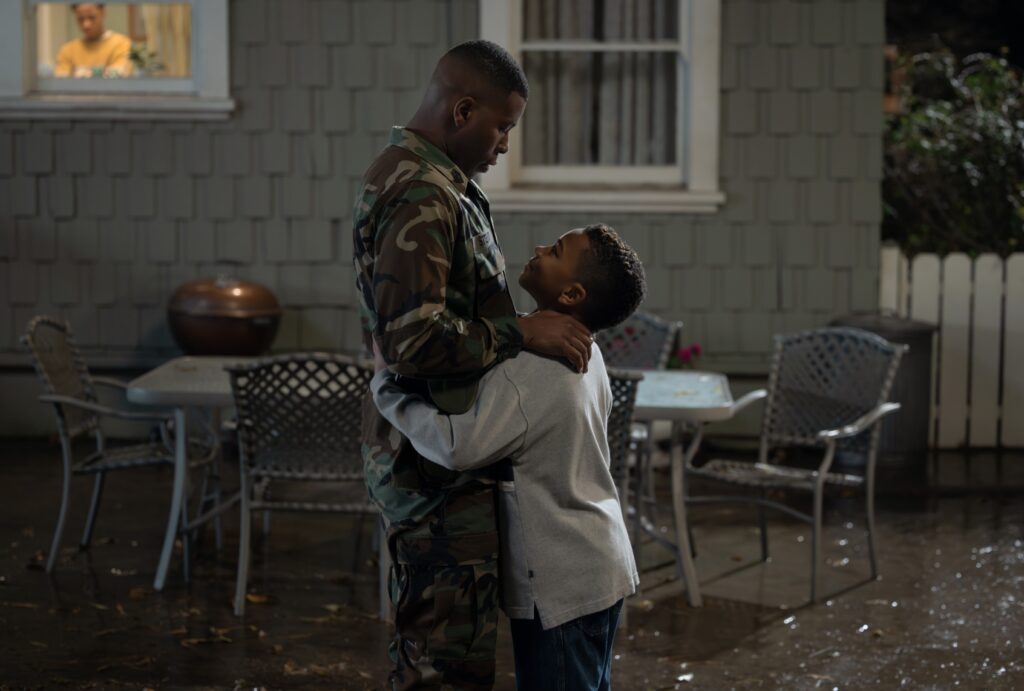
(John Johnson/HBO Max) J. Alphonse Nicholson and Cairo Cash Lee in “Lanterns”
Bernadette’s sickened expression acknowledges she knows this conditioning is abusive. But, as all would-be John Stewarts and Olivia Popes know, it’s also preparation. Training from a parent compensating for a jackpot the universe’s casino denied them, by teaching their kid how to read a deck and calculate the odds.
While Rowan Pope’s hard wisdom about being twice as good gets plenty of replays, hardly anybody quotes the rest of his speech. “You’re not rare,” he tells his child. “You’re not special. Your story is no different than 1,000 other stories in this town.” Then he tells her what he knows will happen next. They, meaning the white establishment, “will lull you into a false sense of security, and then, once your belly is exposed, they will cut you and everyone you know, and they will be swift about it. And by the time you realize you should be fighting back, well, you’re already bleeding to death.”
The Stewarts know that story, too.
Want more from culture than just the latest trend? The Swell highlights art made to last.Sign up here
For all the brutal methods they use to raise John, the most potent observations in this hour of “Lanterns” are tender. Parents like John Sr. and Bernadette realize how heavily heroism drags on a person, and the exhaustion of being the first or the only to breathe rare air in exclusive company. “Courage is fear that’s said its prayers, son,” Bernadette tells John as he recovers from having his path derailed by a familiar spoiler. “You could be worried, but you have to be brave enough to still try. Because one day every little boy is gonna want to be just like you. But until then, you have to make yourself happy.”
Eventually John meets his fate by falling through a portal into an abandoned mall, then following signs directing him to a manager’s office hidden in its bowels. The Guardian waiting there tells him to stay put and leaves him in his chair overnight. She is surprised to find him there when she returns the next morning. John, however, is unfazed. They exchange pleasantries, then the conversation pauses.
“This is when most candidates ask, ‘Why me?’” she says.
“Oh, no,” he responds. “I know exactly why me.” The satisfying part is, so do we.
New episodes of “Lanterns” premiere at 9 p.m. Sundays on HBO and HBO Max.
Read more
about superheroes in TV and film