

Legislation, education, and lead buyback programs are together making a dent in the number of loons killed by lead poisoning. Lynn M. Stone/Nature Picture Library
This story was originally published by bioGraphic and is reproduced here as part of the Climate Desk collaboration.
In 1987, wildlife veterinarian Mark Pokras was in his office at Tufts University in Massachusetts when a colleague from New Hampshire called. “I’ve got a dead loon here,” she said. “If I bring it down to you, can you tell me how it died?”
Understanding what’s killing wild animals is often the first step to saving them, and over the course of his career, Pokras has necropsied everything from whales to hummingbirds. Yet this was his first loon—in part because common loons (Gavia immer) had only recently begun repopulating New England after being nearly extirpated by 300 years of hunting, pollution, and habitat loss. European settlers so disliked these “ill-shap’d” birds that nature writer Henry David Thoreau described his neighbors on Walden Pond in Massachusetts shooting them just for fun. By the early 1900s, common loons—which winter on the coast and spend summers nesting along inland lakes—had disappeared from their breeding grounds in Massachusetts and much of New Hampshire, and been reduced to a fraction of their former abundance elsewhere in New England. Places with names like Loon Pond didn’t see nesting loons for more than a century.
With the banning of DDT and the passage of the US Clean Water Act in the 1970s, however, loons began returning to the region, and people came to see them as symbols of a recovering wildness. The birds’ red eyes and geometrically patterned black-and-white plumage are instantly recognizable, but loons are most beloved for their long, tremulous vocalizations. In the same way that a train whistle symbolizes the freedom and loneliness of travel, loon calls have come to represent a specific, nostalgic kind of northern wilderness: piney woods, the clean smell of a lake, perhaps a rustic cabin tucked away on shore. Flannel shirts, bug spray, an early morning fishing trip. Scientists say that smell is the sense most strongly connected to memory, but for people with a connection to such lakes, there’s nothing like the sound of a loon to conjure an entire place, an entire feeling. Some locals can identify individual birds by the sound of their voices.
Pokras witnessed loons’ rebranding firsthand. As a kid in the 1950s, he remembers occasionally seeing and hearing loons while canoeing with his dad, but loons were no more or less popular than any other wild animal. Today, homes across northern New England display loon flags and loon mailboxes, and gift shops sell loon blankets, loon sweatshirts, loon wine glasses, and nearly any other item you can imagine with a loon on it. Maine residents can get a license plate featuring a loon, and one New Hampshire resident told me that people who grow up there often get one of three tattoos: the state area code (603), the state motto (“Live Free or Die”), or a loon. She chose the loon.
Pokras doesn’t have a loon tattoo, nor any other tattoos for that matter. But he’d become enchanted by loons while volunteering to rescue seabirds after a series of oil spills in New Jersey, and when his colleague asked if he’d necropsy a dead loon on that otherwise ordinary day in 1987, he readily agreed.
Cutting into the bird, Pokras discovered that it had suffered from lead toxicosis, more commonly known as lead poisoning. Loons eat pebbles to help digest food in their gizzard, and this one may have mistaken a lead sinker left behind by a fisherman for a pebble, or perhaps eaten a fish with a lead sinker in its body. In Pokras’s X-ray, the sinker showed up as an unnaturally round ball amid a mess of partially digested fish and shellfish. After the bird ate it, the lead would have leached toxicants into the bloodstream, causing impaired vision, gastrointestinal distress, neurologic issues, and ultimately death.
“This is weird,” Pokras remembers telling his colleague. “We’ll probably never see this again. But if you ever find another dead loon, give me a call.”
“This is weird. We’ll probably never see this again. But if you ever find another dead loon, give me a call.”
That sentence changed the trajectory of his life.
Today, Pokras and his colleagues have necropsied nearly 5,000 dead loons, mostly from New England. Other scientists and veterinarians have necropsied more from across the species’ breeding range, which extends across most of Canada and the northern United States. In nearly every place—from the Maritimes to Minnesota to Washington State—lead poisoning is the leading cause of death for adult loons in freshwater habitat. A loon that ingests a single 28 gram (1 ounce) lead sinker left behind by a fisherman will likely die in two to four weeks.
The late poet Mary Oliver witnessed this loss. In a poem titled “Lead,” she wrote that “the loons came to our harbor / and died, one by one / of nothing we could see.”
In an era when many species are declining because of multipronged, seemingly intractable problems, the solution to protecting loons is relatively straightforward. Anglers simply need to swap their old lead jigs and sinkers for tackle made from tungsten, steel, tin, or bismuth. Given loons’ immense popularity, you might think that would be an easy sell. But although conservationists have tried educating the public for decades—and although Maine, New Hampshire, Vermont, and Massachusetts have laws regulating the use and sale of lead fishing tackle—lead is still responsible for around 25 to 30 percent of loon deaths in most states and provinces, and until recently, nearly 40 percent in New Hampshire. Why?
The answer, at least in the United States, is entangled with gun rights.
I meet up with Mark Pokras on a green, humid summer morning at the headquarters of the Loon Preservation Committee (LPC), a nonprofit based near Lake Winnipesaukee, the largest lake in New Hampshire. Though he retired from Tufts in 2015, Pokras facilitates an interorganizational effort to study loons and drives from his home in Maine to LPC’s wood-shingled building a few times a year to help run a summer research fellowship for graduate students. Today, two Tufts students, Brynn Ziel and Khangelani Mhlanga, are preparing to necropsy a female loon who had been brought to a wildlife rehabilitation center earlier. The loon had been alive but emaciated, with a length of fishing line emerging from her sinuous neck. Unable to save the bird, staff euthanized her, then sent her frozen body to LPC for examination.
Now, the body is splayed on a stainless steel grate above a large, shallow sink, like the kind that might be used for dog grooming. The loon’s organs—esophagus, gizzard, liver, intestines—glisten in the fluorescent lights, and the interns’ nitrile-gloved hands are smeared with blood. Ziel uses forceps to pluck pieces of shellfish from the gizzard, while Mhlanga works on severing the head. The loon is surprisingly large up close—about the size of a goose. The digits on her webbed feet look like long, gnarled human fingers topped with black nails.
Pokras occasionally chimes in with an observation, and Harry Vogel, LPC’s senior biologist and executive director since the late 1990s, looks on from across the room. We’re two hours into the necropsy, and the frozen bird is starting to thaw. The room smells a bit like roadkill.
“They’re a lot prettier on the outside,” Vogel comments.
“I’m biased,” Mhlanga says, “but I think they’re pretty on the inside, too.”
The interns continue disassembling the bird’s internal architecture in silence, then Mhlanga pulls out a fishing hook as long as her finger. “Huh,” Pokras says, examining it. “This is the CSI part—the detective work…I’m looking at this and asking, ‘Is that the reason the bird is emaciated?’”
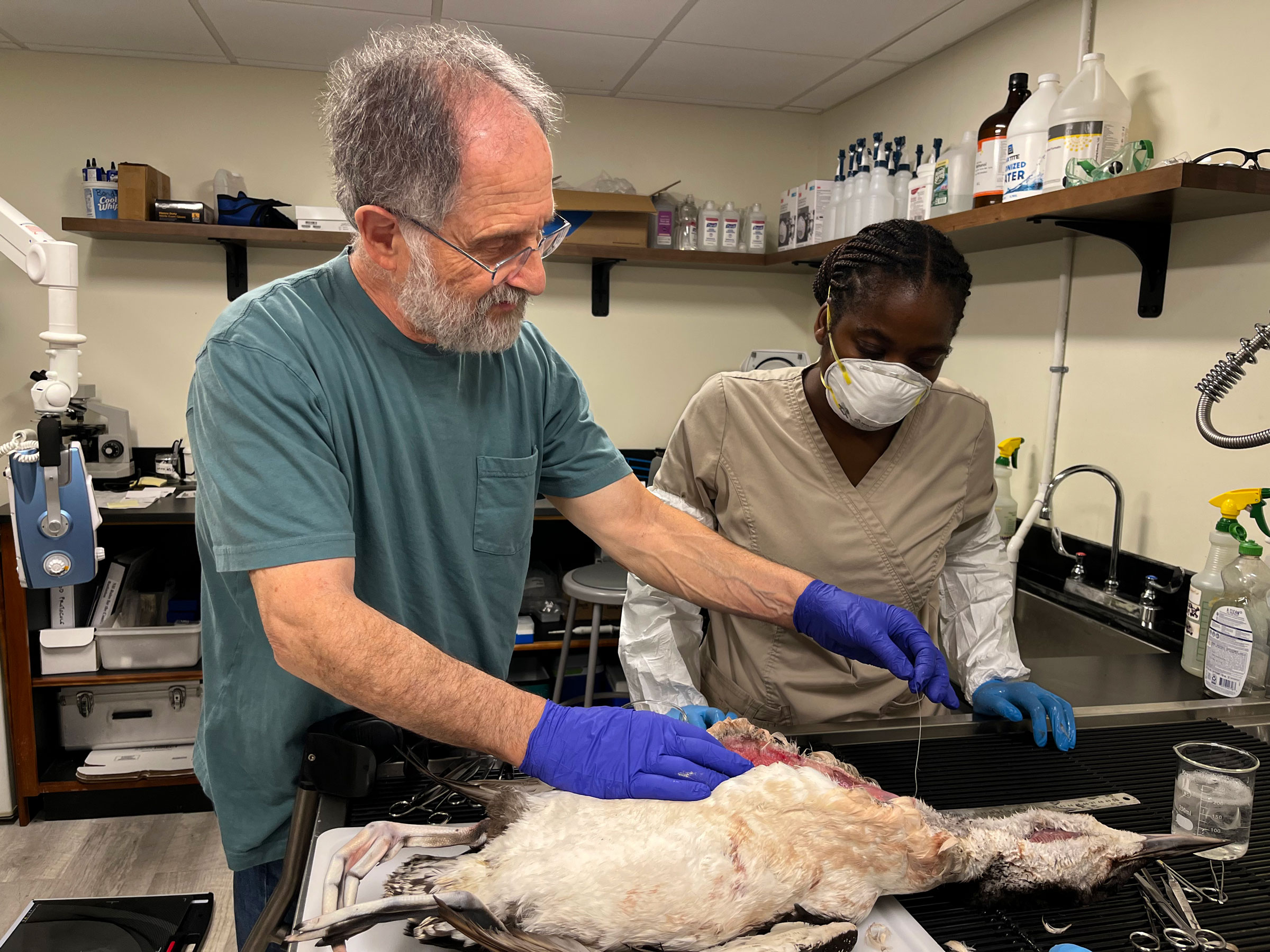
Fishing hooks aren’t typically made of lead—it’s too pliable—so the team doesn’t suspect lead poisoning. Perhaps the hook inhibited the animal’s ability to hunt or swallow, leading to starvation. Still, the necropsy is valuable because it contributes to an ongoing record of the lives and deaths of New England loons across five decades.
When Pokras first realized the scope of lead poisoning while necropsying loons in the 1990s, he imagined the problem would be solved relatively quickly. After all, once Silent Spring author Rachel Carson publicized the harm that DDT was causing to birds and other wildlife in North America in the 1960s, legislators and the general public mobilized against the agrochemical industry and worked to ban DDT in much of the world, saving the lives of countless birds and ensuring that springtime still resonates with their songs.
Yet efforts by LPC and others to educate anglers about the dangers of lead tackle and convince them to switch to non-lead gear hardly moved the needle. And by the time conservationists took their work to Congress in the late 1990s, hoping for a federal ban, it was becoming harder to pass environmental legislation. Voters in the US were increasingly divided by party lines, and politicians were increasingly influenced by a powerful group: the National Rifle Association, or NRA.
As Pokras and his colleagues were spreading the word about the dangers of lead fishing tackle in the ’90s, it just so happened that other conservationists had begun noticing that piles of guts contaminated by lead bullets and left behind by hunters were poisoning scavengers, like bald eagles and California condors. (The US Fish and Wildlife Service had banned lead shot—a type of ammunition used for bird hunting that consists of a spray of small pellets rather than a single bullet—for hunting waterfowl in 1991, but other types of lead bullets were still used for hunting larger animals, and continue to be used today.) Conservation groups across the country began lobbying for a federal ban on lead bullets. And the NRA responded in force. As one NRA website currently states: “The use of traditional (lead) ammunition is currently under attack by many anti-hunting groups whose ultimate goal is to ban hunting.”
But how did the fight over lead bullets thwart efforts to regulate lead fishing tackle? Many hunting and fishing organizations have ties to the NRA, and they maintain that any effort to regulate tackle will open the door to regulating ammunition, and that any effort to regulate ammunition is an assault on Americans’ gun rights.
“One of the unusual things about lead is there are very few other toxic materials that have a huge public lobby in favor of them,” Pokras says. “You don’t see a lot of members of the public out there campaigning [for] more DDT or neonicotinoid pesticides. But with lead there’s a huge, wealthy, politically influential contingent supporting it.”
When Pokras retired in 2015, he had decades of data showing that lead fishing tackle was killing loons, along with some 7,500 peer-reviewed scientific papers that unequivocally show the dangers of lead for wildlife. When I asked why he continues to necropsy loons to amass new data despite this preponderance of proof, his answer is concise: “We haven’t solved the problem yet.”
Lead—an element found not just on Earth but throughout the solar system—has always been attractive for human industry. The earliest known case of metal smelting can be found in 7,000-year-old lead beads found in Asia Minor. The Roman empire produced 72,000 metric tons of lead at its peak, much of it was used to make vessels for eating and drinking and pipes for moving water; the word “plumbing” comes from the Latin word for lead, plumbum. And lead has been harming people and animals for nearly as long as we’ve used it. Lead seeping from a Greek mine was already polluting the environment some 5,300 years ago, while an Egyptian papyrus from 3,000 years ago depicts a case of homicide by lead poisoning.
Still, lead remains popular, used in everything from car batteries to computer screens.
Global lead production increases annually, with more than 4 million metric tons (some 10 billion pounds) mined or extracted through recycling in 2024 alone.
Before traveling to New Hampshire to seek out loons, I’d met with Elaine Leslie, the retired chief of biological resources for the National Park Service, at her home in rural southwestern Colorado. When Leslie was leading the Park Service’s biology department in the early 2010s under Barack Obama’s administration, she helped enact an internal ban on lead ammunition in all US national parks and preserves. Hunters and gun advocates weren’t thrilled—“I got death threats,” Leslie tells me matter-of-factly—but the US Fish and Wildlife Service followed suit by banning lead ammunition in certain national wildlife refuges, and began making moves toward a more comprehensive ban. The state of California also banned lead bullets in condor habitat in 2007, eventually followed by a statewide ban. For a while, it seemed as though scientists and conservationists were making progress.
But when President Donald Trump took office in 2017, his administration largely reversed the Park Service’s ban on lead bullets. (Rangers must still use non-lead bullets when dispatching an injured animal.) It also restricted the agency from spending money on research, education, or other efforts to reduce lead impacts to wildlife and people. Such pushback is bolstered by gun advocates who claim there’s no research proving that lead has population-level effects on wildlife. In the case of California condors, they say, California’s lead ban hasn’t reduced mortality rates, so the lead in condors’ blood must be coming from a different source. (Scientists say it’s because condors regularly cross into states like Arizona and Nevada and eat meat left by hunters who used lead bullets.) Critics also claim that non-lead ammunition is more expensive, which used to be true but is becoming less so. And they allege that non-lead ammunition is less effective—another argument that has been disproved in peer-reviewed research. Still, the backlash against regulating lead at the federal level has only grown in recent years, with federal legislators introducing bills to protect hunters’ and anglers’ right to lead tackle and bullets. California remains the only state with a complete ban on lead ammunition.
Sitting in the shade of her porch sipping iced tea, I asked Leslie, a wildlife biologist by training, if the science showing the dangers of lead to animals is well established. She let out an incredulous laugh. “There’s so much peer-reviewed science out there,” she said. “There’s study after study.”
“Those are the very top of the iceberg. Grizzly bears are impacted. Coyotes are impacted. Ravens are impacted. Any animal that eats another animal can be impacted.”
For months after our meeting, Leslie sends me those studies by email. Research has shown lead poisoning in doves, whooping cranes, eagles, owls, and many other birds. And as Leslie points out, those are only the animals that are monitored. “I mean, those are the very top of the iceberg,” she says. “Grizzly bears are impacted. Coyotes are impacted. Ravens are impacted. Any animal that eats another animal can be impacted.” While not every animal that absorbs lead dies from it, the bioaccumulation may lead an animal to become sluggish or disoriented and get struck by a car or fly into a power line it would have otherwise avoided. Lead poisoning, Leslie says, is an underreported issue.
While most animals killed by lead poisoning encounter the element from bullets, loons are predominantly killed by lead fishing tackle, which is theoretically less contentious to regulate—especially in progressive regions like New England. That’s why, beginning in the early 2000s, loon conservationists turned their focus to state-level laws. They also kept their efforts to ban lead tackle separate from efforts to ban lead ammo, in the hope that it might be an easier pill for lawmakers to swallow.
New Hampshire became the first to ban certain types of lead fishing tackle in 2000, and subsequently strengthened its laws to become some of the most stringent in the nation. Vermont, Massachusetts, and Maine followed, though the details differ so much from state to state that education and enforcement remain challenging. “We thought great, problem solved,” says Vogel, the LPC director. “But then we realized the problem was not solved.”
Today, even after the bans have been in place for years, LPC continues to receive loons each year who have died of lead poisoning. Vogel and his colleagues initially thought this was because the birds were swallowing old lead sinkers buried in the muck at the bottom of lakes. But after necropsies demonstrated that the months when most loons died of lead poisoning coincided with the months when freshwater fishing was at its peak, the team realized that the deaths came from current use. Fishermen were still using—and even purchasing—lead sinkers and spinners.
Back at the LPC’s headquarters on the shores of Lake Winnipesaukee, Pokras shows me a lead lure that he picked up at a fishing store in Maine a few weeks prior. “This is actually a good thing,” Vogel chimes in, with characteristic optimism. It means conservationists don’t have to figure out how to remove old tackle sunk at the bottom of lakes. If they can just figure out how to keep new lead tackle from getting into the environment, the benefit to birds should be almost immediate. And fortunately, they’ve found a promising solution.
After the interns finish taking samples of the dead loon’s organs to send off for testing, they seal what’s left of the body in a heavy-duty trash bag for disposal at the local dump. As they wrap up, I head upstairs to the education center and gift shop. A recording of loon calls plays softly, and educational exhibits share information about loons, including the fact that they can dive to depths of 60 meters (200 feet) to hunt for fish, and that their name comes from the Swedish word for clumsy, lom—a nod to loons’ notorious ineptitude on land.
On one wall, a taxidermied loon appears to be suspended mid-swim in a glass case, its neck stretched out and its webbed feet splayed behind it like propellers. Affixed to the glass is a placard: “This loon died after ingesting lead fishing tackle.” A table below displays a jar half full of lead sinkers: “This small Mason jar contains enough lead fishing tackle to kill every adult loon found in New Hampshire!” Nearby, a wooden bowl carved in the shape of—you guessed it—a loon holds non-lead tackle that visitors can take home for free. Brochures urge people to earn credit for more new tackle by turning in their old lead gear.
This is part of New Hampshire’s pioneering lead tackle buyback program. LPC gets generous donations from loon lovers, and along with support from the state’s department of fish and game, some of that money becomes $20 vouchers to sporting goods stores given to people who turn in lead tackle. Banners and flyers publicizing the lead buyback program are displayed at waste transfer stations, government offices, shops, and community lake associations, and Scouts can earn a badge for collecting lead tackle from their community. Since its launch in 2018, people have dropped off nearly 80,000 pieces of lead tackle; in 2024 alone, 78 kilograms (172 pounds) of lead tackle were turned in, marking a 119 percent increase over the prior year. Maine has taken the work a step further—in addition to buying tackle from individual anglers, the conservation nonprofit Maine Audubon buys stock directly from merchants, keeping lead tackle off the shelves and helping stores comply with newly tightened state regulations.
For loons, the combination of legislation, education, and buyback programs seems to be working. Lead poisoning is no longer the number one killer of loons in Maine. And in New Hampshire, lead-related deaths dropped 61 percent between the late 1990s and 2016, and fell another 34 percent since then. “I suppose you could see New Hampshire as a leader,” Vogel says, “But that’s also driven by necessity. The problem was the most severe here.”
Vogel is optimistic that states like Minnesota, Wisconsin, and Washington—all of which have significant loon habitat—will one day follow suit, along with his home country of Canada, where 94 percent of common loons breed. Canada already bans lead tackle and ammo in national parks and wildlife areas but allows it elsewhere. Resistance to a Canadian national ban seems to come from a more basic reluctance to change, rather than fear of losing gun rights, along with the fact that loons are so abundant in Canada that preventing lead poisoning feels less urgent.
Europe, meanwhile, is far ahead. The European Union, Norway, and Iceland already ban lead in all wetlands, and the EU is considering a proposal to ban lead from all fishing and hunting gear. Denmark already has a complete ban, and the United Kingdom will enact one beginning in 2026.
With the necropsy complete, I follow Vogel and Ashley Keenan, LPC’s field crew coordinator, to a small motorboat docked on Lake Winnipesaukee. The southern part of the lake bumps with party boats and Jet Skis, but these northern reaches are quieter, scattered with islands and ringed with coves where dark sweeps of pine forest feather the shore.

Vogel and Keenan are tracking this year’s loon chicks. Unlike ducks and many other waterfowl, loons hatch only one or two eggs per year and don’t typically reproduce until they’re six years old, making population-level growth slow. Out of 32 nesting pairs of loons scattered across Lake Winnipesaukee’s 179 square kilometers (69 square miles) in the spring of 2025, 12 chicks had survived as of August. The figure is slightly below average, although survival rates fluctuate. (One year, 23 chicks survived, Vogel tells me; a few years later, only three did.) During Keenan’s last patrol, the eggs in one nest perched on a tiny island hadn’t yet hatched, and today she’s trying to find out if the chicks have emerged.
Keenan steers toward the island, cuts the motor, and jumps into the shallows. She aims her binoculars at a cluster of lichen-splattered boulders. We wait in silence. Nothing.
“Goddamn it,” she says, climbing back into the boat. One egg might still be there, but there’s no sign of the second egg or a living chick. She guesses it was picked off by a predator, perhaps an eagle. Vogel speculates that unseasonably hot summer weather contributed to the lower-than-usual survival rate. Loon parents who need to cool down by going for a swim must leave their eggs unguarded, opening them to predation or overheating under the blazing sun.
Although common loon populations are holding steady or even growing slightly across their range, loons are increasingly susceptible to the impacts of climate change, as well as avian malaria, shoreline development, and collisions with recreational motorboats. And this region—one of the first in North America to be settled by colonists, and still one of the most densely developed on the continent—echoes with stories of species that have disappeared, from mountain lions to American chestnuts. People here know that survival is never guaranteed, and that keeping common species common requires effort, sacrifice, and care. For loons specifically, it means keeping as many adults of reproductive age alive as possible.
“This is probably the most intensely managed species in New Hampshire,” Vogel says. “And despite that, we’re still having trouble maintaining reproductive success.”
Just then, a white-haired woman in a kayak approaches our boat, waving her arms. “I’m just trying to find out what happened to my baby loon,” she calls out. Her name is Dotty Wysocki, and she’s been watching nesting loons near her summer cottage here for three decades. “We name ’em and everything,” she tells me in a thick Boston accent. “We really get involved. I’m constantly looking for them.”
Wysocki tells us that she saw a newly hatched chick alive earlier in the week but hasn’t spotted it since. When Keenan affirms that the chick is likely dead, Wysocki lowers her eyes. She wishes she could have done more; when she was younger, she and her friends used to watch the chicks in four-hour shifts to scare off eagles and other predators.
At the end of her poem about lead poisoning in loons, Mary Oliver wrote: “I tell you this to break your heart / by which I mean only / that it break open and never close again / to the rest of the world.”
As Wysocki paddles away and Keenan starts up our motor, both seem dispirited, perhaps even a little heartbroken. But their concern for the fate of this one tiny chick nonetheless fills me with hope. It’s the kind of love that can save a species, and indeed, the only thing that ever has.


