

Something curious happened on a flight into New York this week, something I’ve never witnessed on any of the many flights I’ve taken into the city in my 13 years of living here. Upon landing, the flight attendant’s voice rang over the intercom to give us the usual spiel as our aircraft made its way to the jet bridge. After informing passengers of what gate we were pulling into, the flight attendant added, “And please, do not accept rides from any unauthorized drivers offering car service in the terminal. Follow the posted signs for the taxi line or ask a service desk for more information.”
It’s not that I’d never heard this sentiment before. Posted signage throughout the terminal warns everyone who lands at a New York airport about overpriced and potentially dangerous scam rides. What surprised me was that I’d never heard the alert before actually deplaning, and certainly never heard it verbally, let alone by someone working for the airline. “Maybe the problem has gotten worse in the convenience age, when people want their ride as fast as possible,” I thought. In that case, it’s good advice. But I feel she could’ve thrown in a few more practical, equally evergreen warnings — especially since it takes an additional hour to deboard anyway: “Do not accept mixtapes in Times Square or attend any ‘free comedy shows’”; “If you’re waiting more than 20 minutes in a line or for a table, go somewhere else”; and, most importantly, “If you see the Subway Takes guy on the train with his tiny microphone, swat the mic out of his hand and get off at the next stop.”
The tiny microphone makes everything about itself. It’s a scene-stealer, a class clown. It demands attention yet offers nothing. Worse: The tiny microphone begets equally small questions.
The tiny microphone has taken over city streets and college towns, while subsuming video-based social media entirely. In a recent study (conducted by me), doctors (that I paid off) concluded that before-bed scrollers are more likely to wake in a cold sweat, reeling from a nightmare about someone on the street shoving a tiny mic in their face to ask what song they’re listening to. These nanoscopic audio devices aren’t just silly and undignified — more on that in a moment — they’re inescapable, popping up everywhere from Instagram interviews to red carpet premieres and award shows. Even if tiny mics are a trend that’s crossed over from influencer culture, they’ve become yet another obnoxious staple of the film industry that favors a viewer’s pleasure over decorum. Not everything needs to be kitsch, dumbed down, or turned into a competitive status symbol, lest anyone take that as another excuse to care even less about the wrong things. So, in a new year, while we’re still holding onto resolutions with a white-knuckle grip, these are a few things that film culture should leave on the cutting room floor.
The movie theater “quick pic”
I’d hoped that authoring a guideline to movie theater etiquette at the start of 2025 might put enough determined energy into the universe to halt bad theater behavior once and for all. I was quickly proven wrong. Poor theater etiquette is still going strong, and there were plenty of “SHHH”s doled out through the last 12 months. This is a battle I’ll wage for the rest of my life; I’ve accepted that. But in the meantime, there’s one particular aspect of bad theater etiquette that I can’t shake: The movie theater “quick pic.”
The quick pic is when someone in the theater takes out their phone during a film and thinks to themselves, “I’m just going to snap one quick pic, no one will see me!” Yes, they will. Fifteen people just saw this picture being taken, along with the second and third pictures taken for safety. As brief as these instances might be, they’re just as aggravating and distracting as pulling out your phone to check Instagram. (I’m talking to you, gay guy who sat in front of me at “Honey, Don’t!” and liked Taylor Swift’s album announcement with your phone on full brightness.) The quick pic is sometimes even more ignorant, because its perpetrators believe they have some kind of special technique to avoid disturbing other patrons. If one needs a photo of their favorite scene so desperately, buy a matinee ticket for a Tuesday morning and sit in the back row, as long as no one else is next to you. But just know you’re desecrating a sacred space.
Tiny microphones and tiny questions
Imagine: You’re an actor about to hit the red carpet for the premiere of your new film. Everything has been leading up to this. You’ve honed your craft, studied incessantly and brought every part of yourself to this character and this movie. This is the performance that made all those years of striving for your art feel worth it. It could very well be your legacy — a career-defining performance, and you couldn’t be prouder. With a deep breath and a quick fix of your posture, you stroll onto the carpet and are greeted by a row of interviewers asking you to hold onto a tiny microphone while an iPhone films you at 4k resolution from your worst angle.
“It’s fine,” you think. A professional comes prepared for any hiccups, after all, and you’re ready to bare your soul to the press, down to answer any question about this role, your process, your thoughts about the character, anything at all. Then, tiny mic in hand, you must reveal something much more personal and far more precious: “Which of your fellow cast members would you want to have with you on a deserted island?”
Want more from culture than just the latest trend? The Swell highlights art made to last.Sign up here
For every thoughtful, interesting question asked of an artist on a red carpet or during a junket, there are three more vapid ones, and offenders almost always have a tiny microphone. While clip-on microphones and other small yet mighty audio devices are genuinely good for discreet sound recording, the tiny microphone makes everything about itself. It’s a scene-stealer, a class clown. It demands attention yet offers nothing. Worse: The tiny microphone begets equally small questions. There is so much fluff out there, so much pomp and circumstance. Do we really need to hear what Netflix show would get an actor through the apocalypse?
Why is this happening? Why have our finest actors been forced to make mockeries of themselves, looking like the Jolly Green Giant if he were holding a normal-sized microphone? An artist of Julia Roberts’ caliber should not be holding a tiny microphone, and yet, she has! A full-sized mic might be more inconvenient to travel with, but there must be pride in the work, and a regular microphone is infinitely more professional, even just on a visual level. Luckily, Emily Blunt wasn’t just brave enough to turn in a decent performance in one of last year’s worst movies, but so strong-willed she called out this awful trend. “Tiny little mic,” she said, grimacing at a recent premiere. “Oh my god, these are so weird.” Blunt, indeed!
(A24) “Marty Supreme” Wheaties
Mile-long movie merch lines
When parents of the ’90s and ’00s were spending the holiday season waiting in line to push and shove for Tickle Me Elmos and Furbies, did they ever imagine their children would do the same for movie merch? A “Marty Supreme” jacket may be a far more durable purchase than a bunch of simple robotics covered in cheap plastic and fur, but the craze is the same. At the tail end of 2025, lines to purchase one of the “Marty Supreme”-branded windbreakers, specially made by sportswear brand Nahmias, stretched as far as the eye could see. From New York to Los Angeles, São Paulo to London, prospective viewers waited for hours, sometimes even overnight, for the chance to drop $250 at a movie merch pop-up event. This increasingly popular way to draw hype and promote films was taken to its apex by Timothée Chalamet’s “Marty Supreme” press tour, which saw the actor flaunting different versions of the jackets and sending them off to his famous friends and personal icons like Kris Jenner and Tom Brady. Even Susan Boyle got her hands on a “Marty Supreme” jacket.
But when it’s all said and done — when the pop-ups are torn apart and the “retail space for rent” signs are hung back in the window — what’s left is a fleeting status symbol, meant to be worn a few times for clout points. The “Marty Supreme” jackets are already on resale websites, priced between $350 and a whopping $3000, all to sucker people into buying merch that will likely be sold online in the near future, as was the case with other movie merch pop-ups. And while anything that could drive ticket sales or bring people together is a good thing in my book, these pop-ups feed the same fear of missing out that drives our worst behavior and spending decisions, all for a jacket that will collect dust by summer.
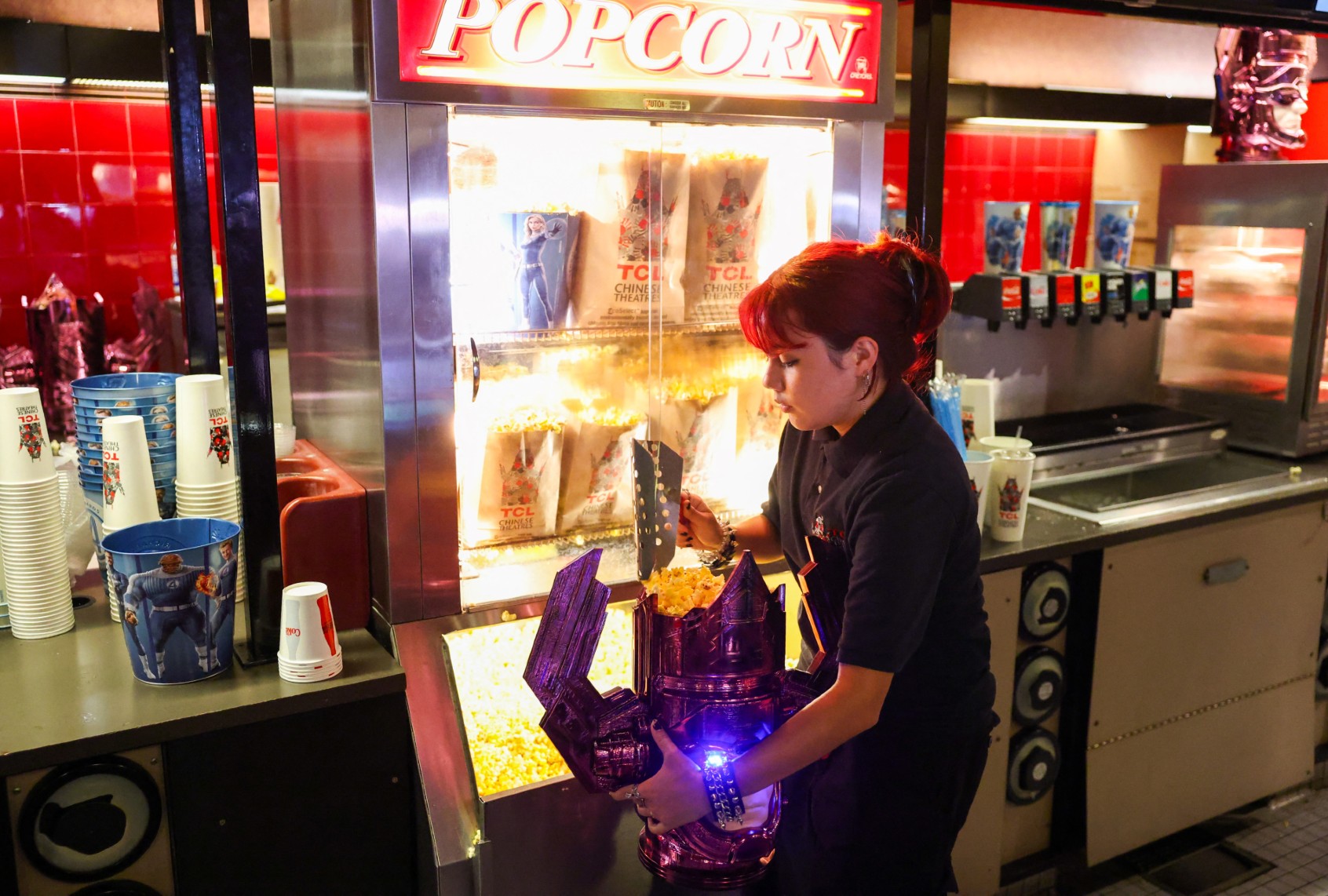
(PATRICK T. FALLON/AFP via Getty Images) Marvel’s “Fantastic Four” Galactus popcorn bucket, which set a Guinness World’s Record for “Largest popcorn container commercially available”
The novelty popcorn bucket
A related but debatably worse hyper-consumerist cash grab in the film space, the novelty popcorn bucket is a disaster for cluttered movie theater stockrooms and the bane of existence for designers, who must come up with new and increasingly frustrating ways to make a popcorn bucket unf**kable.
In my day, theater chains printed film marketing assets onto a round plastic bucket that you’d designate as the “throw-up bucket” to keep under your bed in case of emergency. Now, we can eat popcorn out of Stitch the Alien’s furry blue butt or M3GAN the robot’s head. Is nothing sacred? Is there anything that can’t be monetized? Porn culture is already rampant enough; we simply do not need to be putting more holes in objects. I can’t be unwillingly subjected to someone “experimenting” with a “Jurassic World Rebirth” T. rex on my timeline. Not again, not even if someone out there is collecting them for fun and not sex. Keep your junk out of this junk, I beg.
Unnecessary post-credits scenes
“Sinners” is a great movie, partially because it has something for everyone: music, action, horror, romance, two Michael B. Jordans. What more could you want? That’s the question writer-director Ryan Coogler should’ve asked when he decided to include not one but two post-credits scenes in the film, one that appears halfway through the final batch of text, and another that bookends the entire affair.
The scenes are fine. They flesh out the narrative just slightly enough not to feel entirely superfluous. But they also make Coogler’s epic vision feel noticeably less confident. “Sinners” speaks for itself. It’s a rollicking, intense adventure about music and the way it bonds us through history. Its ending is resolute. There’s no more that needs to be added, but the modern blockbuster demands crowd service. Coogler undoubtedly knew viewers would be waiting to see if any additional bits would arrive during the credits, and it’s fun to give audiences something extra to chew on. But like most end credits scenes, the ones in “Sinners” are redundant and disappointing.
This tactic has become so popular that entertainment sites have become factories designed to churn out end-credits scene explainers for every film that may draw a wide audience. It’s one of the modern absurdities that still makes little sense to me. Why are we sitting in movie theaters after the lights go up, googling “Does ‘Hamnet’ have an end credits scene”? We should be able to leave the movie and not feel like we missed anything if we didn’t stay until the janitors started to sweep.
These scenes, like every trend in discussion here, are useless for the filmmaker and for the viewer. These unsavory gimmicks do nothing but provide more encouragement to reduce art into something fun to post about online. They exist under the guise of bringing us together, but only make us more greedy, isolated and incurious — not to mention broke. That’s my story, and I’m sticking to it. Tiny mic drop.
Read more
about the good and bad in film culture


