

“28 Years Later” introduces Ralph Fiennes’ Dr. Ian Kelson as a man accustomed and somewhat resigned to being taken for something he isn’t. From a distance, the physician hermit looks like a lunatic living among rage-crazed monsters, painted head to toe in blood, scavenging for corpses to make pillars of their bones.
Only those who dare to get close enough to speak with him, including the film’s young protagonist Spike (Alfie Williams), find out the truth. It isn’t blood reddening Kelson’s skin, but iodine. His meticulously assembled forest of skulls, femurs, tibiae, and fibulae isn’t sacrilege; it’s a memorial. “Every skull is a set of thoughts,” he gently tells Spike. “These sockets saw, and these jaws spoke and swallowed. This is a monument to them. A temple.”
At the climax of “28 Years Later: The Bone Temple,” Kelson receives Spike again, a short time later, under changed circumstances. This time, his young friend accompanies satanists who have mistaken the doctor for the Devil. But their leader, Sir Lord Jimmy Crystal (Jack O’Connell), is the one offering a deal: Kelson can either play the part or die horribly.
Kelson chooses performance, and turns out a showstopper that director Nia DaCosta renders in golden glory. Transforming his sacred ossuary into a marvelously profane stage and donning a rock star’s black trench coat, Kelson wields fire and brimstone while delivering a lip-synch of “The Number of the Beast” fit to shake the gates of Hell. A God’s-eye view captures sparks and flames tearing a circle around his unholy play.
(Columbia Sony Pictures Entertainment) Ralph Fiennes as Dr Ian Kelson in “28 Years Later: The Bone Temple”
Lasciviously scampering up his mountain of skulls, he looks every inch a prince of darkness, entirely in his element as a showman. But that is not who Kelson really is. Through the first two films in Danny Boyle and Alex Garland’s planned trilogy, the audience comes to know him as a reserved loner who prizes calm. He’s a preserver of life, a keeper of human memory. He also prefers Duran Duran to heavy metal.
Nevertheless, when a homicidal maniac demands a dance with the Devil, Kelson can neither refuse him nor comply half-heartedly. His so-called “bone temple” is an actualization of his life philosophy, memento mori, which translates from Latin as “Remember you must die.” To Kelson, it’s a reminder to savor what time we still have — and this may be his final worldly act.
So he thumbs through his modest record collection and brings forth Iron Maiden’s 1982 classic. “OK,” he says softly. “Let’s turn this one up to 11.”
Everyone loves a desert island playlist, and just about everyone fears being the last sane person left on Earth. When we play the desert island game, we do it with the tacit acknowledgement that its proposed diversions are impractical. If a Rage virus decimated society with lightning alacrity, as it does in Boyle and Garland’s “28 Days Later,” losing your albums and artwork would be the last thing you’d worry about.
Survivalists prioritize practicality, economically packing go bags with necessities like medicine, water purification remedies, a few days’ worth of food, a blade to cut through branches or pierce the rotting skull of a starving attacker.
And yet, in a version of Britain the rest of Europe has abandoned to death and lawlessness, Kelson survives because of his dedication to artistic and scientific curiosity.
Those concepts interlace in his ossuary, enlivened when he plays his tenderly kept records, remnants of human joy all but lost to a Rage pestilence. Kelson views art as an extension of human capability. Like science, artistic inspiration originates from the stuff that makes up our bodies – our brains, hearts, muscles, and skeletons. As most of what we create is destined to be forgotten, so too are our bones. You can call that depressing, or an indignity, or a simple fact.
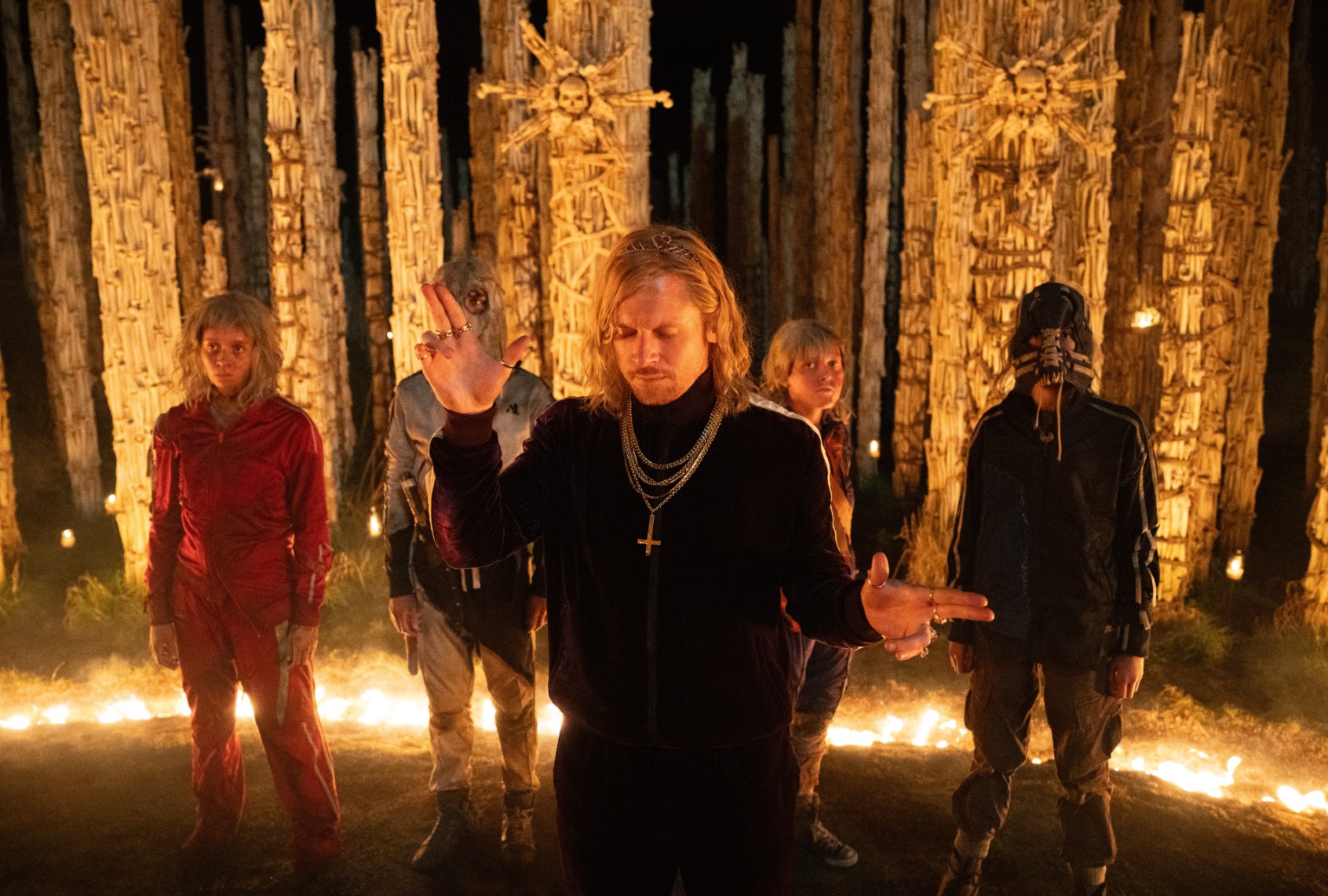
(Columbia Sony Pictures Entertainment) Jack O’Connell as Sir Lord Jimmy Crystal in “28 Years Later: The Bone Temple”
What the incurious may condemn as sacrilege is meant to be a blessing most of the unclaimed or forgotten dead aren’t fortunate to receive, and a reminder that each of us is born with works of art inside of us, structures with the potential to outlast plagues.
Kelson’s memento mori, in its way, adds dignity to what is otherwise a sentence to nothingness. It’s a reminder to live in the moment, even if that means facing possible death with theatrical glamor and a rock show for the ages.
Jimmy Crystal and his butchering followers, whom he calls the Fingers, are especially dangerous because they blindly believe Jimmy’s claim to be the anti-Christ, tasked with fulfilling his dark father’s mission to lay waste to the Earth. But O’Connell’s cultist, a character inspired by entertainer and notorious sexual predator Jimmy Savile, isn’t god, devil, or monster, merely a damaged psychopath grasping for power.
Even he is formatively defined by influential media: “Teletubbies,” a late ‘90s children’s show starring a foursome of smiling, babbling characters with TV screens in their bellies. Its weirdness and gentle teachings about play, cooperation, and basic concepts like shapes and color made it a phenomenon. But the same surreal traits that won over small children also made them popular among ravers coming down from their ecstasy voyages.
Tinky Winky and the rest imprint on Jimmy, a vicar’s son, as the final image of innocence he can recall before a group of Rage-infected people devoured their neighbors, friends, and Jimmy’s family. His father’s final act is to hand him his crucifix, which Jimmy eventually turns upside down and claims as his authoritarian totem.
Entertainment is overrun with the undead to a degree that most zombie movies and TV shows aren’t even scary. Between Zack Snyder’s interpretations of George A. Romero’s “Night of the Living Dead” films, “The Walking Dead” and all its spinoffs, even its common figurative value is diluted. Zombies doubling as a metaphor for consumerism or groupthink? How very mid-20th century. Even more recent insights that other people are more dangerous than the flesh-eating undead are played out. To Boyle’s credit, “28 Days Later” was among the first to make that point, way back in 2002.
But from the start, Boyle pointed out that his roving, snarling bipedal hunters aren’t truly dead, merely lost to a Rage virus that renders them incapable of higher thought — but capable, perhaps, of being returned to their senses.
In a recent Rolling Stone interview, Boyle dropped a thought that explains Kelson’s narrative purpose: “What happens if our culture dies?” he asks. He was referring to our reliance on technology for communication and artistic transmission, unifying tools in modern society. “28 Years Later” and “The Bone Temple” answer that question in different ways. In the first chapter, the loss is functional; Spike’s community on Holy Island is entirely analog. Without modern communications grids, cell phones are useless.
As most of what we create is destined to be forgotten, so too are our bones. You can call that depressing, or an indignity, or a simple fact.
In “The Bone Temple,” Kelson keeps his connection to culture alive, but it takes work. He powers his record player and the modest lighting in his tiny underground bunker using a hand-cranked generator. But he also finds inspiration throughout a land strewn with remains.
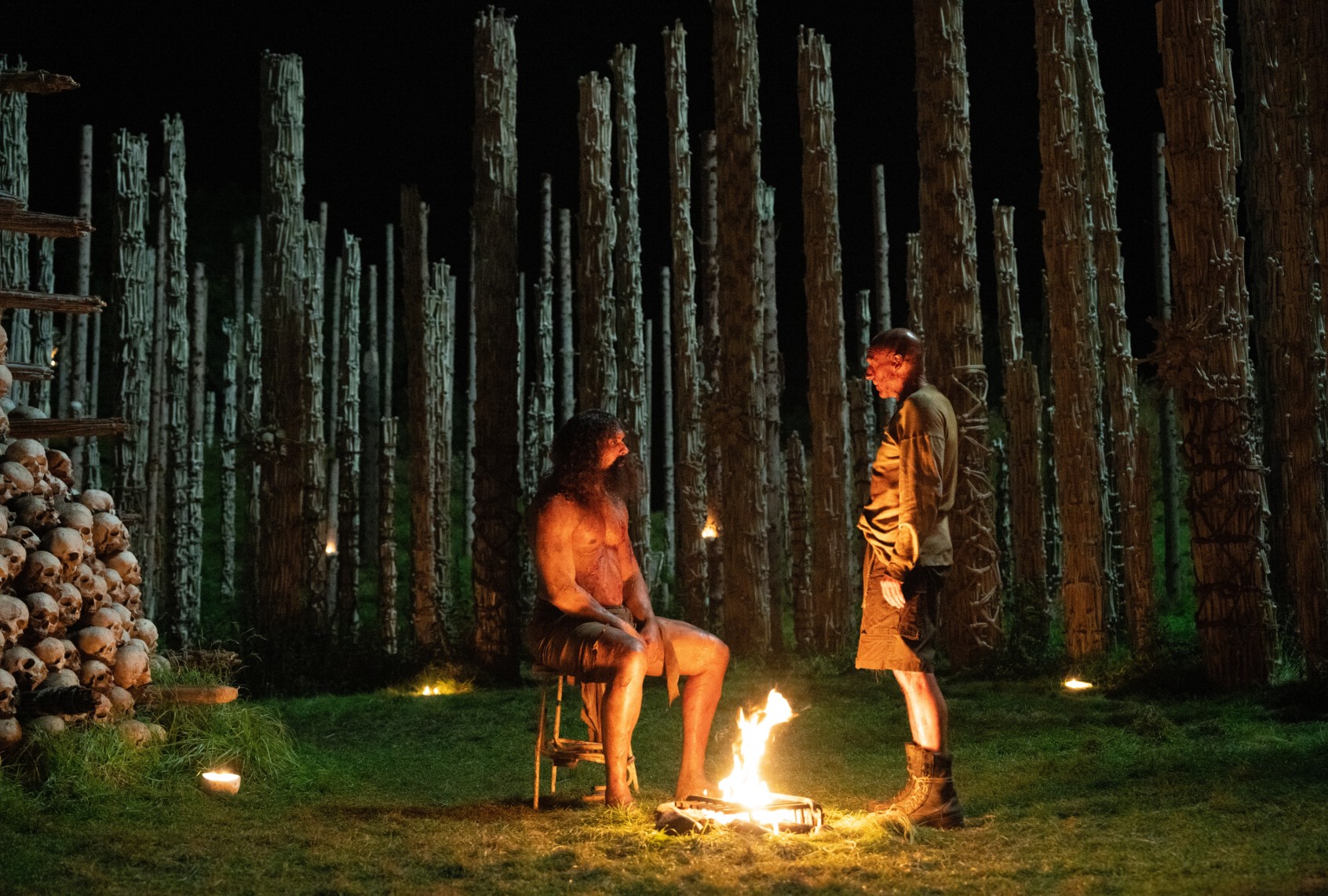
(Columbia Sony Pictures Entertainment) Chi Lewis-Parry as “Samson” and Ralph Fiennes as Dr Ian Kelson in “28 Years Later: The Bone Temple”
Kelson knows that his Bone Temple is a strong defensive measure. Any prudent passerby would think twice before approaching a clearing with a tower made of hundreds of skulls at its center. For the mindless infected, he’s created a cocktail of morphine, a painkiller, and xylazine, a sedative, delivered by blow dart.
But the Bone Temple is not an exclusive place. Kelson prioritizes a peaceful life, not necessarily one sequestered from other people. When, in “28 Years Later,” Spike asks Kelson to explain the structure, Kelson expresses relief that someone finally posed that question, fearing he’d die without ever sharing his intent with another living soul. Lasting art can be mysterious and often misunderstood; this can also be said of ossuaries.
He intermingles the bones of infected and non-infected alike, he says, “because they are alike.” What the incurious may condemn as sacrilege is meant to be a blessing most of the unclaimed or forgotten dead aren’t fortunate to receive, and a reminder that each of us is born with works of art inside of us, structures with the potential to outlast plagues.
Want more from culture than just the latest trend? The Swell highlights art made to last.Sign up here
Still, there’s no denying the immortal power of drugs and rock n’ roll. When Kelson’s chemical intervention halts a sprinting Alpha he’s named Samson (Chi Lewis-Parry), Kelson finds he can coax his dangerous patient to receive his soothing words, eventually fascinating the Infected brute enough to join him for a few clumsy dances to “Rio” and “Ordinary World.” The morphine may grant Samson respite, Kelson realizes, but connecting to life’s wonders, natural or manmade, may be the key to restoring Samson’s set of thoughts. And the infected Alpha does regain a sliver of mental clarity. Just not in enough time for Kelson to outrun Jimmy Crystal’s torturing tent revival.
Hence, Fiennes’ outrageous pageantry sharpens “The Bone Temple” into a tragedy as opposed to just another bloodbath.
End-of-the-world sagas in film and TV, in concert with the downward societal spiral made inevitable by late-stage capitalism, have given rise to a fearful definition of survival. Our wild imaginations and real-world confrontations with disaster, whether wrought by humans or Mother Nature, only solidify our more anxious interpretations of preparedness. At the very least, the wise among us have emergency kits, while enthusiasts hoard canned goods and weapons.
But Fiennes’ Kelson suggests that if all the lights do flicker out, sustaining our humanity will also be essential. Art and science blaze a path forward for him in a world all but destroyed by thoughtless fury, making it all the more lamentable when a band of ignorant, bloodthirsty zealots threatens to snuff out his progress. It’s a familiar predicament in any society fraying around the edges, and immensely uplifting to see his cornered humanist rage against oblivion with an explosion of white-hot metal bright enough to leave an indelible mark on the long, angry night.
Read more
of Salon’s brainy zombie coverage


