

Last year, shortly after his second inauguration, President Donald Trump issued a proclamation on January 31 to mark the start of Black History Month the next day—just as presidents before him had done, beginning with Gerald Ford in the bicentennial year of 1976. He invoked “heroes such as Frederick Douglass, Harriet Tubman, Thomas Sowell, Justice Clarence Thomas, and countless others [who] represent what is best in America and her citizens.” A well-known golf enthusiast, he paid special tribute to Tiger Woods, one of many “who have pushed the boundaries of excellence in their respective fields.” Hailing the arrival of “a historic Golden Age,” Trump extended gratitude to “black Americans” (notably a lower case “B”) “for all they have done to bring us to this moment.”
A few weeks later, Trump hosted a Black History Month reception at the White House. Tiger Woods, wearing his Presidential Medal of Freedom (2019), was the guest of honor and gave brief remarks. The president acknowledged other attendees, including Senator Tim Scott (R-SC) and former NFL player Scott Turner, newly confirmed as the Secretary of Housing and Urban Development. The president touted his connections to the African-American community and paid tribute to “the generations of black legends, champions, warriors, and patriots who helped drive our country forward to greatness.”
Though nobody there mentioned it, Trump’s 2025 Black History Month reception took place in the shadow of a previous order from January 20, terminating “illegal” Diversity, Equity, Inclusion, and Accessibility offices and initiatives across all agencies of the federal government. According to the president, Americans deserved a government that hired and fired solely based on merit. Previous DEIA programs, the order stated, had not only been “[an] immense public waste,” but also an example of “shameful discrimination.” On the same day Trump proclaimed the start of Black History Month, his Secretary of Defense, Pete Hegseth, issued his own stark directive: “Identity Months Dead at DoD.”
Fast forward to February 2026, and Trump’s latest Black History Month proclamation is something vastly different, both at the rhetorical level and in its deeper meaning. It begins in the usual way, by recognizing America’s Black heroes and “legends” (used, unironically, in its colloquial form), but then it veers into subtle diatribe. “As president, I proclaim that ‘black history’ is not distinct from American history—rather, the history of black Americans is an indispensable chapter in our grand American story.” Sticking with the lower case “B” in all references to Black people and Black history, Trump has further twisted the shape and meaning of Black History Month. What other presidents have recognized as a month for community education and public acknowledgement—a celebration of African-American achievements, but also an observance of past injustices—Trump has harnessed for his own purposes. Black History Month, perhaps unsurprisingly, has become a battleground of memory and a new front in MAGA’s broader culture war.
Presidents make history at two levels: first, by taking decisions and implementing policies that change the lives of millions (or billions), but also by invoking and narrating the past in their own, often idiosyncratic, ways.
From a historian’s perspective, Trump’s attempt to co-opt and reconstrue Black History Month isn’t surprising. In the courses I teach on “History and Memory” and “The Politics of History,” students learn that presidents have always taken a role in the construction of American collective memory. Presidents make history at two levels: first, by taking decisions and implementing policies that change the lives of millions (or billions), but also by invoking and narrating the past in their own, often idiosyncratic, ways. They do this to influence how they will be seen in the future, but also to legitimate (and lubricate) the exercise of power while still in office.
Whether Democrat or Republican, progressive or conservative, presidents have always instrumentalized the past to advance their political agendas. On the way to the 1776 Bicentennial, Presidents Johnson and Nixon both tried to orchestrate the celebration to calm and manage the crises of the day: Vietnam, the struggle for civil rights, urban unrest, student protests, and economic recession. In their inaugural speeches and State of the Union Addresses, presidents spin historical yarns and elaborate their platforms through historical analogies and homespun presentations of the past. All of that is normal, even if, for historians, these presidential forays into history can be exasperating.
Trump’s efforts to change the shape and meaning of Black History Month are something different. The production of historical knowledge, whether by presidents or academics, always reveals and depends on the existing power structure. It always entails distillation, sanitization, selectivity, and, of course, who gets a say when it comes to giving the past its meaning. No interpretation of the past is apolitical, but the question of power also begs the question of moral vision and practical outcomes.
To what purpose and in support of what principles and values do we put our investigations of the past? When we explain and interpret the past, we do so in pursuit of knowledge and understanding—but to what end? What other goals shape and drive historical inquiry besides familiarity with the facts? Facilitating justice by accepting responsibility for past violations and abuses committed in our names? Or is the purpose of the past merely to maintain the hierarchies of knowledge, opportunity, and citizenship that deliver benefits to some while sidelining and brutalizing others?
It isn’t Trump’s sophomoric dabbling in history that is unusual; it is his determination to use the past for baldly illiberal purposes. Not for the purpose of affirming the uniqueness and dignity of all individuals and groups, but to force all Americans into a framework that appears to be neutral on the outside, even as it gives credence and political standing to some groups more than others. What makes Trump’s history dangerous is how it camouflages identity politics with a slick veneer of group neutrality. Not the identity politics of the last 40 years, for which MAGA has so much contempt, but the identity politics of an earlier age, when Black equality may have existed on paper, but Black Americans faced cruel and violent barriers to full citizenship, and American history, where it featured Black bodies, rarely incorporated Black voices.
Consider, again, Trump’s use of language in his 2026 Black History Month proclamation. At first, he sticks with familiar tropes that recall the nation’s origins: “America’s founding was rooted in the belief that every man, woman, and child is created equal, ‘endowed by their Creator with certain unalienable Rights,’ and free to live […] in ‘pursuit of Happiness.’” But things soon take a dark and radical turn. “For decades, the progressive movement and far-left politicians have sought to needlessly divide our citizens on the basis of race, painting a toxic, and distorted, and disfigured vision of our history, heritage, and heroes.” Yes, this certainly sounds dire, but fear not, Trump will correct the nation’s course, as only he can. “This month […] we do not celebrate our differences. Instead, we celebrate the contributions of black Americans to our national greatness and their enduring commitment to the American principles of liberty, justice, and equality.”
It isn’t Trump’s sophomoric dabbling in history that is unusual; it is his determination to use the past for baldly illiberal purposes.
Throughout the proclamation, Trump pulls in two opposite directions. On the one hand, there is an inclusive, even charitable, aspect. Black history is seemingly accepted and embraced here. It should be viewed, Trump declares, as “indispensable.” His language melds Black history with American history, imbuing it with grandeur. Black patriots, he says, have been “the vanguards of our freedom” and are “some of the most heroic Americans to have ever lived.” The emphasis is on the unum in our nation’s oft-cited motto: e pluribus unum (out of many, one).
On the other hand, for many African-Americans, it will be hard not to feel slighted. Trump frames Black history in language that suggests it does not—indeed, by implication, it cannot— stand on its own. It exists to be subsumed into something broader and deeper. There is no singular Black experience in America’s past, it seems, except what Trump and MAGA choose to remember. You can see this in Trump’s 1776 history project, where Martin Luther King, Jr., appears, unfathomably, as a warrior in the fight against reverse racism.
The scare quotes around “black history” (“I proclaim that ‘black history’ is not distinct from American history…”) are also telling. Black history isn’t history at all, but only a kind of pseudo “history.” It may entail real events and real people, but, until it is absorbed into the MAGA past, it holds no real value. When Trump said, during a Black History Month event in 2017, that the 19th century abolitionist Frederick Douglass was “an example of somebody who’s done an amazing job and is being recognized more and more,” some saw his framing as yet another product of his narcissism. But it is also an example of how Trump appeals to the past while simultaneously ransacking and appropriating it for his own purposes. If Trump could copyright or affix a trademark to the past—not to mention monetize it—does anyone believe he would miss that chance?
In the next section, the president invokes that hardy perennial, the Declaration of Independence—2026 being the country’s Semiquincentennial—and he cites America’s “bedrock belief in equality.” The word “bedrock” does a lot of heavy lifting here, signaling something consolidated and foundational. For Trump, equality is enmeshed deep in America’s historical DNA. The nation’s history is the story of its genomic expression, and in Trump’s world, that DNA must remain pure. Anything that doesn’t fit must be excised. The text continues: “The source of our strength is rooted not in our differences, but in our shared commitment to freedom under one beautiful American flag.” One people, one nation, one history. Every strand of the past must be smoothed, with no ends left frayed. You can almost imagine Trump in the archives, sorting through America’s messy past with a hot iron and a pair of golden scissors.
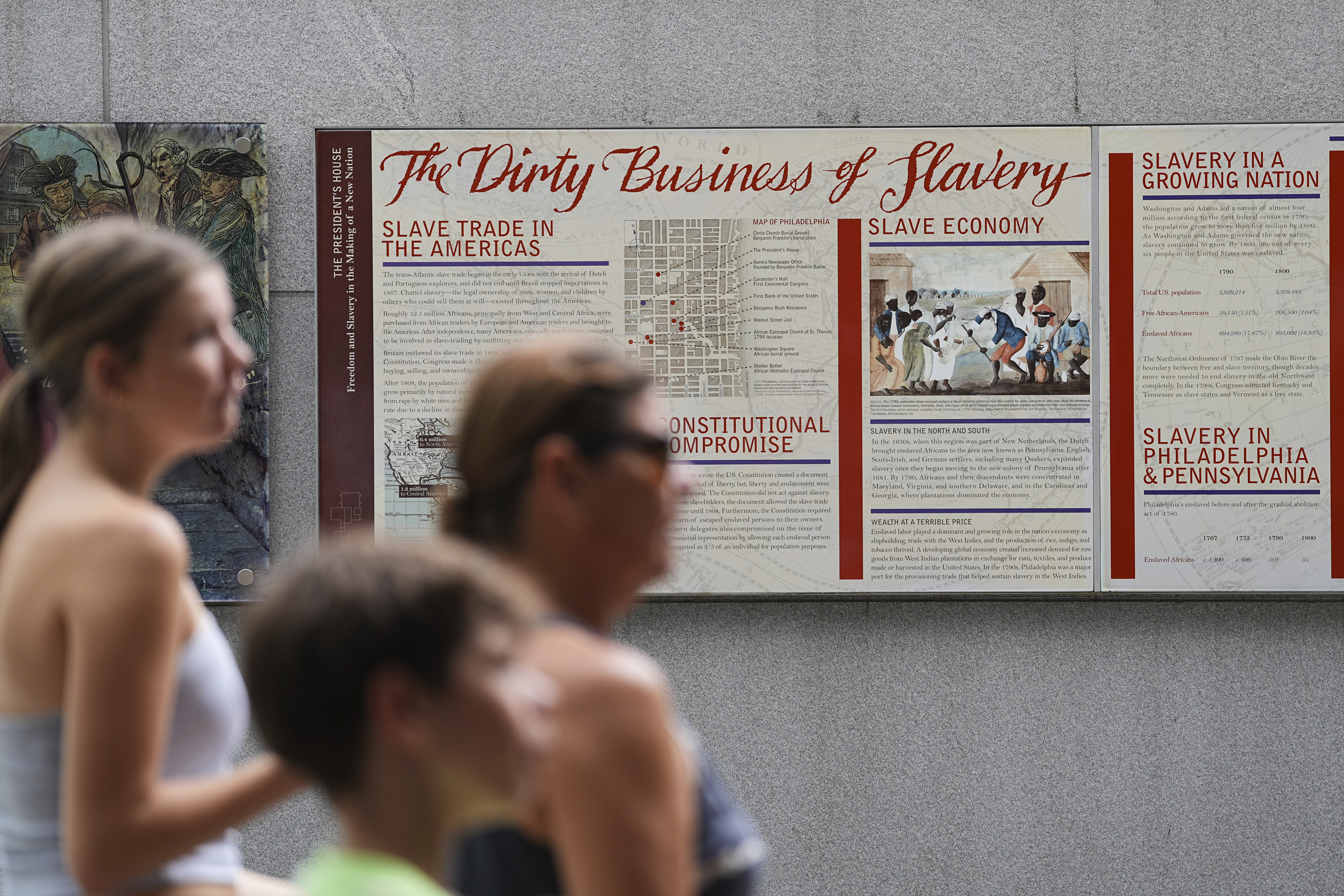
Perhaps the best example of MAGA revisionism can be seen in the series of outsized claims Trump makes regarding America’s lead role in a story of liberation, technological achievement, and moral progress. America, he announces, “wrested the Western Hemisphere from monarchies and empires, ended slavery, saved Europe, put a man on the moon, and” (cough) “built the freest, most just, and most prosperous society ever known to mankind.” It’s not as if Black Americans aren’t present in the proclamation; indeed, they are remembered and honored for their contributions to a sweeping and triumphal story. But, at the same time, they are wrestled into place. They appear and attain their meaning in the distorted role Trump has chosen for them. They must live within a history that is imposed on them.
Clearly, Black Americans contributed enormously to their own emancipation and the writing of their own history. From the end of slavery to the civil rights movement to the 1619 Project—whatever one thinks of it—the story of Black Americans is fundamentally a story of the vast and complicated tapestry of Black memory. How could Donald Trump, or anyone for that matter, have the final say over Black memory? How can Black History Month ever be aligned with MAGA’s ideological project? Can it really be, as this year’s proclamation wants us to believe, that slavery was “ended” in the United States without ever having started—that is, without having been deliberately created and propagated and profited from by our patriots of yore?
The importance of Black History Month isn’t the way it can instill patriotic pride or paper over glaring inequalities and differences in lived experience. It is its ability to fill the voids in official accounts of the past and un-silence the voices that have too often gone unheard.
Since its observance began, Black History Month has been an opportunity to explore the nation’s past through new sources and to enrich our collective self-understanding through the cultivation and inclusion of new perspectives. The importance of Black History Month isn’t the way it can instill patriotic pride or paper over glaring inequalities and differences in lived experience. It is its ability to fill the voids in official accounts of the past and unsilence the voices that have too often gone unheard. We can, of course, celebrate and admire Black achievement and Black accomplishment and what Black excellence has added to America’s historical ledger. That was part of what led Carter G. Woodson to launch the first Black History Week in 1915. But Black history cannot be made to serve Trump’s memory of America except through deliberate and, I’ll say it, violent acts of erasure.
Before he was president and well before he became a fixture on our screens and in our feeds, Trump was a swaggering playboy New Yorker who fancied himself a builder. Recently, he has returned to form, demolishing the East Wing of the White House to build a giant ballroom and, more recently, announcing the closure of the Kennedy Center for the purpose of a major renovation. (Also, since he slapped his name on it, the collapse of ticket sales and artists refusing to perform there has made this important cultural venue unsupportable.) He appears to think obsessively about his legacy and how to leave an architectural imprint on the future.
On the National Mall, or perhaps the banks of the Potomac, Trump has proposed to raise a massive “Independence Arch” to commemorate the semiquincentennial. A 250-foot behemoth for our 250 years of self-governance. Elsewhere on the Mall, Trump has viciously attacked other monuments and sites of memory. Last summer, he railed against the National Museum of African-American History and Culture for having betrayed its mission. Instead of our country’s great success, he said, the museum was overly focused on “how horrible our Country is” and “how bad slavery was.” American history, Trump has said many times, should always be patriotic, and museums should not dwell on or stir up negative aspects of the past. There is only one American history for Trump; all others are untruthful and insane.
So, what is it he sees in his arch that is missing from the African-American history museum? Why is the Smithsonian’s cutting-edge museum of Black history and culture in the MAGA crosshairs while Trump’s monstrous arch is thought to embody the nation’s full glory?
The answers seem clear.
One remembers pain and broken promises, while the other erases them. One points to a multitude of experiences and perspectives, while the other flattens everything into a single unified plane. One demands moral reflection and soul searching, while the other hawks untarnished greatness. One is a space for civic dialogue, while the other dictates meaning and broaches no dissent. One is a story of democracy, imperfect but hopeful, while the other is a story of raw and ravenous power.
The Czech novelist Milan Kundera wrote, famously: “The struggle of man against power is the struggle of memory against forgetting.” But sometimes it’s the struggle of memory against counter-memory, remembering against remembering otherwise. When it gathers up a selection of perspectives and discards others, when it engraves certain stories and sands down others, memory is a form of power. With power comes great responsibility.
That’s the struggle over Black History Month right now. In many ways, however, it has become a microcosm of a far greater struggle, even an existential one in the face of an authoritarian’s fever dream. Trump so desperately wants his monolith. All Americans need to fight now more than ever, for a complex, democratic past. In the end, that may become the real meaning of Black History Month in our semiquincentennial year.
Top image: Mother Jones illustration; PHOTO12/ZUMA; COVER Images/ZUMA; Molly Roberts/White House/Planet Pix/ZUMA; Tony Vaccaro/Getty; Wikimedia


