

“In Times of Dragons,” the new album from Tori Amos, dropped on Friday, and in order to prepare, I have listened to more Tori Amos in the past two days than I’ve ever listened to before in my life. Which is, to be fair, not a high bar to clear: Before this week, I’d never intentionally listened to Tori Amos. I’d heard her music over the years, in snippets and snatches: on the radio, on MTV or VH1, at karaoke, on the soundtracks of streaming shows. If her voice came trilling out of a car speaker, I recognized it. However, at no point in the last 36 years have I ever thought, you know what would really hit the spot right now? A little Tori Amos.
Even people who write about popular culture for a living have their flat spots. I’ve never seen “Forrest Gump,” never read Agatha Christie and was unfamiliar with “The Goonies” until two decades ago, when I moved to Oregon and realized they turn you away at the California border if you can’t quote any of it. Despite being a ’90s woman and a feminist and a former music writer and the owner of more than one deck of Tarot cards, I knew next to nothing about Amos. It’s not on purpose; it’s also not thoroughly not on purpose. So, when my editor says, “Hey, Tori Amos’ new album comes out soon,” with what I assume is the goal of doing some spitballing about coverage, I have nothing.
(Matthew Baker/Getty Images) Tori Amos performs onstage during her “In Times Of Dragons” UK and Europe Tour at Royal Albert Hall
Monday, 2 p.m.: Having nothing has somehow become committing to a Tori Amos crash course, 48 hours of full-tilt, balls-to-the-wall Tori. There’s not enough time to listen to Amos’ entire catalog, so I take recommendations: My editor sends a slew of YouTube links; my former coworker Theo directs me to playlists. I start at the beginning and listen to tracks from Amos’ first two albums — 1992’s “Little Earthquakes” and 1994’s “Under the Pink.” I recognize a total of two songs: “Crucify,” the first single from “Little Earthquakes,” was an MTV staple for a time, and “Cornflake Girl,” which I remember hearing in 1993 and was most recently used to haunting effect in the second season of “Yellowjackets.”
Despite being a ’90s woman and a feminist and a former music writer and the owner of more than one deck of Tarot cards, I knew next to nothing about Amos. It’s not on purpose; it’s also not thoroughly not on purpose.
Amos’ voice shimmers and twinkles and slides, unhinged but in a meticulous kind of way. Most of all, it is deeply, terrifyingly feminine: expressive, operatic, mercurial. It takes up space. It saturates.Its arpeggios and shrieks and growls are resonant, and shortly after that, repellent. It is somehow incredibly self-assured and nakedly vulnerable. I suddenly understand why Tori Amos wasn’t on my radar: she couldn’t be. I text Theo: “Can someone just be too emotionally unavailable for Tori Amos?” following up with a second text that should have read “too many feelings” but instead comes out as “too feelings.” Eventually, she replies with a winky-face emoji.
Want more from culture than just the latest trend? The Swell highlights art made to last.Sign up here
Amos calls her fans “ears with feet” — they hear everything she feels and feel every note she hits. Moving on to “Boys For Pele,” I realize, not for the first time, that being a ’90s woman means viewing more things than I’m comfortable with through a scrim of internalized misogyny. I know this isn’t true for every Gen X woman, but my cultural tastes were formed at a time when cultural tastes were male tastes — not always as a result of deliberate sexism, just the standard operating procedure of a time when men were both the decision-makers and the target audience for most things. Norms and narratives were set largely according to what men wanted to see and hear and experience; for kids, in particular, the most visible, aspirational girls were male-identified tomboys.
Again, this isn’t true across the board, obviously, but in the ’70s and early ’80s, a lot of girls experienced the transition from girlhood to womanhood as a loss of status they didn’t have the language to understand. I’m reminded that in 5th grade, after a single hour of sex education during which the boys went to the gym and the girls stayed in class, we were given a send-away coupon for a menstrual-product starter pack whose accompanying pamphlet bore a title that, in retrospect, sounds like a threat: “Growing Up and Liking It.”
Male identification was simply the cultural status quo, and sometimes it was fine, and other times not so much. I was introduced to Dolly Parton, for example, not as one of America’s premier songwriters but as a lady whose prominent breasts were frequently the subject of jokes on “The Johnny Carson Show,” often made in front of Parton. My first encounter with Patti Smith was a quote in a music magazine in which she called rock ‘n’ roll a man’s job; that live music, for her, was about a display of muscle and sinew, “not some chick’s tit banging against a guitar.” The women whose videos I most looked forward to seeing on MTV — Pat Benatar, Tina Turner, Annie Lennox and The Pretenders’ Chrissie Hynde — shared a reassuring androgyny. My favorite band was The B-52s, possibly because the femininity of Cindy Wilson and Kate Pierson was comically exaggerated with towering beehive hairdos and vinyl minidresses.
I realize, not for the first time, that being a ’90s woman means viewing more things than I’m comfortable with through a scrim of internalized misogyny.
Amos’ “Little Earthquakes” came out to critical praise and commercial success, but it was very much “in the girl drawer,” says author, cultural critic, and longtime Tori defender Jude Doyle. “Her fan base was mostly gay men and young women, and it was very easy to therefore make liking her an embarrassing trait.” As with Kate Bush, the go-to comparison of Amos’ early career, Amos didn’t bring the habitual backbeat or driving guitars of rock, or even the detached attenuation of prog rock. As a young listener, Doyle says, “It’s overwhelming when you are in a culture that says ‘theater kid’ and ‘girly’ are things you want to steer clear of so that you can blend in.”
Monday, 10 p.m.: On his way to the kitchen, my kid pokes his head into my office as I’m quietly weeping at my laptop, listening to “From the Choirgirl Hotel,” the album Amos wrote in the wake of experiencing a miscarriage. “I’m fine,” I say before he can ask. “Just having a moment.”
Tuesday, 9 a.m.: Fact-check: Amos was not, as I believed until several minutes earlier, part of Lilith Fair, the traveling festival of women artists that, from 1997 to 1999, crossed the United States during the summer months. Famously, Canadian singer-songwriter Sarah McLachlan came up with the idea for the festival after a number of run-ins with radio stations that told her apologetically that they could not put more than one lady voice in rotation at a time, or listeners would complain. (Similar policies have, in fact, persisted.) The lineup McLachlan recruited for the festival’s inaugural year — which included headlining performers like Paula Cole (whose former music students are now Amos’ backup singers), Sheryl Crow, Tracy Chapman, India.Arie and Me’shell Ndegeocello, as well as second-stage acts in each city — set out to shift that paradigm.
The wave of women singer-songwriters that crested in the early 1990s was ultimately too much for even the most hidebound radio programmers to ignore, but the first year of Lilith Fair had a triumphal pettiness (complimentary): Its shows quickly sold out, and its novelty drove breathless press. And though I’m almost positive that it wasn’t women who dubbed the event “Vaginapalooza,” men weren’t alone in side-eying the tour: In one oral history of Lilith Fair, Rolling Stone journalist Lorraine Ali noted that, in “taking the most passive thing in popular music that women were doing and putting it forth as the united front of women in music,” the festival foreclosed on showcasing musical innovation.
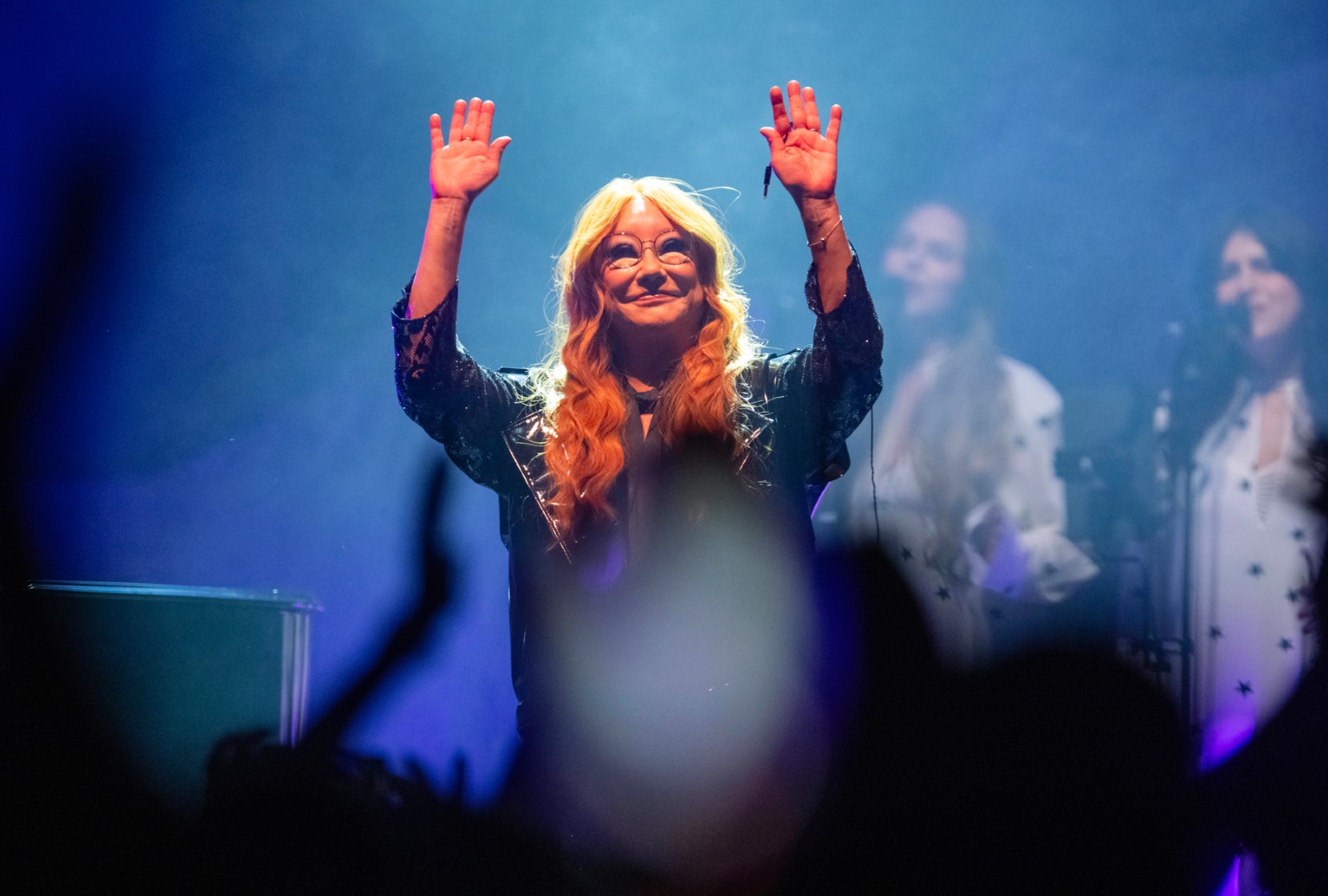
(Matthew Baker/Getty Images) Tori Amos
Amos seemed to agree, and gave Lilith Fair a hard pass, telling Rolling Stone’s Steven Daly, “[M]y shows are theater, and I’ve worked a long time to get them to this point . . . You walk into my show, you walk into a world – it’s a film every night. I can’t impose that on Lilith and vice versa,” and then adding, “Plus, I’m not into the all-male, all-female thing . . . Where’s Dionysus? Where’s Hades? You can’t cut out the testosterone.”
Failing to join up with Lilith didn’t cost Amos a fan base: her audience grew in ways that her ’90s-era peers like Jewel didn’t because she seemed to implicitly understand that what they wanted from her was, first and foremost, connection. “Her fans tended to feel very misunderstood,” Doyle notes. “There were a lot of computer nerds and suburban gay kids and survivors of sexual assault in her audience, and they all saw in her a chance to see their experiences reflected back and taken seriously. If you were involved with punk bands, that might have been where you found catharsis, but if you were out in the suburbs and got your music at Best Buy, Tori Amos was your girl.”
Tuesday, 2:30 p.m.: Nine albums in, my tears have dried up, and my eyes are starting to cross. I skip ahead to the three tracks from “In Times of Dragons” that are available online. The concept album — Amos clearly loves a concept album — is based on America in real time, and follows a protagonist named Tori who married a tech billionaire from whom she’s now fleeing because, it turns out, he’s a Lizard Demon. At a recent event at an HMV in London, she talked with a longtime fan–turned–friend, , about the various spirits and deities that brought the stories to her.
The world has caught up with Amos; the invocations of faeries and muses that once had music journalists barely concealing their amused disdain now exist alongside a whole marketplace of woo. But more important is that nearly everything about popular music — how it’s consumed, written about and contextualized — has changed over the 3-plus decades in which Amos has made music. “A lot of the young women who listened to her [when they were] growing up are now musicians and critics themselves,” Doyle points out. “A lot of the young queer men that connected to her are men who now have voices in the culture that they didn’t before. As little as I vibe with poptimism, its big contribution was in questioning why some artists are automatically considered more serious than others.”
The dismantling of monoculture doesn’t mean there no longer is one — that’s clearly not true, and might never be — but it’s upended the long-held belief that what you listen to is shorthand for who you are. (Or, as Rob, the protagonist of Nick Hornby’s “High Fidelity” and Patient Zero of insufferable record-store guys might put it, what you like no longer takes precedence over what you are like. From what I can glean from interviews over the years, even before Amos had the level of success that allowed her to write her own ticket, produce her own albums, and follow her many muses, she had the temperament and the vocabulary to push back against the lack of nuance that was once considered necessary to appeal to a mainstream audience. Of the term “confessional,” she told New York Times music critic Jon Pareles in 1998, “I don’t like that term, and I’ll tell you why . . . When you confess, you’re asking for absolution. And I’m not asking for anybody’s approval.”
Honestly, same. This marathon of listening hasn’t transformed me into a superfan, but I now understand that my inability to appreciate — to even hear — Amos really wasn’t a fear of femininity, or softness, or unfettered and terrifying emotion. Maybe I just needed time to become a person who understood that embracing demons is sometimes as necessary as accepting them. Maybe the detachment I once saw as armor necessary to muscle through life was too cold and hard to let me pick up what she was putting down. Maybe after the next 9 albums, I’ll know for sure.
Read more
women and music


