

For the last two months, Bruce Springsteen has been staging a nightly protest rally in arenas across America. “The Land of Hope and Dreams American Tour” is part revival meeting, part homecoming and also simply a fine evening of music. But it is absolutely a protest rally, whether people know it going in or not.
“Now they say they’re here to uphold the law, but they trample on our rights.
If your skin is black or brown, my friend, you can be questioned or deported on sight.
In our chants of ‘ICE out now!’…”
Being surrounded by thousands of people yelling “ICE OUT NOW” has the opportunity to be transformative, or at least to make someone think. It is giving people a voice, and it is giving them a container in which to use that voice.
This is the last verse of “Streets of Minneapolis,” Springsteen’s protest song about the murders of Renee Good and Alex Pretti. When Springsteen sang “ICE out now!” during a show in Pittsburgh (as he had in the previous 15 stops on the 20-date tour), the crowd echoed it back to him. This happened in Minneapolis on opening night, this happened in Los Angeles, in Portland, OR, in Atlanta, in New York City, in Chicago. This happened everywhere, and will keep happening in upcoming shows.
But he doesn’t continue with the next line and the final chorus. Instead, Springsteen pauses and sings the line again, this time stepping back from the mic and letting the audience supply, “ICE out now!” And then he comes back, gently: “In our chants of —” “ICE OUT NOW!” — one more time, this time louder and less tentatively from the crowd, before the E Street Band swings back into the song.
It isn’t just a piece of showmanship, either. Witnessing these moments in the audience, it felt as though Springsteen wanted to not just reinforce the message, but give everyone who didn’t know about it in advance an opportunity to consider the request and then give it a try, and once they said it out loud, give them a chance to say it with emphasis or enthusiasm or anger.
And even if there are people in the audience who don’t participate in the chant for whatever reason — they think that ICE just needs some regulation, they believe in the fantasy of “the Kavanaugh stop,” or some position outside of outright abolishing the organization — being surrounded by thousands of people yelling “ICE OUT NOW” has the opportunity to be transformative, or at least to make someone think. It is giving people a voice, and it is giving them a container in which to use that voice.
For a lot of people in that room, it may be their first exposure to participating in public protest. Because that is what this outing is, disguised as a Bruce Springsteen tour. It’s not about creating “a safe space,” it’s about taking an already familiar and comfortable space — a Bruce Springsteen concert! — where you can look around you and clearly see that that nice couple from Highland Park or Edina or Lake Oswego you were chatting with before the show are clearly not radical anarchists with Molotov cocktails in their pockets, but who yelled with gusto. Maybe more people are actually against this than you realized.
As Springsteen reminds the audience, “The E Street Band was built for hard times.”
“Streets of Minneapolis” was originally written and recorded as an acoustic, folk-based protest song — Alex Pretti was murdered on January 24; Springsteen wrote the song on January 24 and released it on January 28th — but on this outing, the 20 cross-country dates that comprise the tour, the song is performed in a full, electric E Street Band arrangement.
The original song, as released, is straightforward folk, just the Boss and his acoustic guitar. On tour, after the first verse that Springsteen takes solo with electric guitar, it enlarges into a bundle of full ringing chords and beautiful vocal harmonies in the back half, and transforms “Streets of Minneapolis” from a simple but powerful protest song into a full-blown anthem. It’s exactly the kind of expanding, heart-filling rock ‘n’ roll ballad that Springsteen has practically trademarked at this point. It’s not just social commentary filling the spot in a setlist, and the only reason we’re hearing it — the only reason it was released — is that it is a genuinely great song.
Want more from culture than just the latest trend? The Swell highlights art made to last.Sign up here
Most of the media coverage — in the few cities that still have newspapers that cover arts and culture — the headline of this Springsteen tour has focused on the series of between-song speeches or introductions that offer a candid, direct, and no-holds-barred series of opinions on the actions of the current administration. Out of a 27-song setlist, these remarks appear four times in the course of the 2 ½ hours the band is onstage. That’s actually not a lot of speechifying if you look at it proportionally. It’s not 150 minutes of anti-Trump rants.
But what Springsteen is actually offering is a message not just through his spoken remarks, but through a carefully constructed narrative arc using the songs that he’s written over the last 50 years, along with three carefully chosen covers: his version of Edwin Starr’s “War,” released 40 years ago; the Clash’s “Clampdown,” which first emerged on E Street when Rage Against the Machine’s Tom Morello filled in for Steve Van Zandt back in 2013 (this time around he’s just a delightful bonus), and Dylan’s “Chimes of Freedom,” which Springsteen took firm possession of on the 1988 “Human Rights Now!” tour in support of Amnesty International.
Unlike most Springsteen tours, this set (and its accompanying remarks) has largely remained the same each night. That is a formula many rock ‘n’ roll acts follow, and no shame to them — but it’s not how Springsteen has operated across the decades. The diehards chase the rarities, Springsteen changes songs in and out as the spirit moves him, and there was one tour where he took requests via sign from the audience. That was an era during which Springsteen was fond of declaring “the majesty, the mystery, the ministry — of rock ‘n’ roll!”
(Matthew J. Lee/The Boston Globe via Getty Images) Bruce Springsteen performs in concert with Tom Morello and the E Street Band
It’s much different when you’re on the road in the service of rallying the troops. The repetition of the setlist night after night reinforces and hones the message Springsteen wants to deliver, but that aspect also provides a challenge to himself and to the E Street Band: when an audience isn’t responding, you can’t change your mind, skip to the next song, or call an audible. You have to find a way to deliver. It’s a challenge that the 2026 version of E Street Band, augmented by horns, a choir, a violin and a percussionist (17 band members total, not counting the lead singer), is more than up to. As Springsteen reminds the audience, “The E Street Band was built for hard times.”
The repetition of the setlist night after night reinforces and hones the message Springsteen wants to deliver, but that aspect also provides a challenge to himself and to the E Street Band: when an audience isn’t responding, you can’t change your mind, skip to the next song, or call an audible. You have to find a way to deliver.
And there’s nothing about this show that is perfunctory. On this tour, even warhorses like “The Promised Land” or “Badlands,” which are always on the setlist, are honed and sharpened. “The Promised Land” comes after “Streets of Minneapolis,” taking on a second life as its own form of protest song, a reminder of “The America that I love, the America that I have written about for 50 years,” as Springsteen has stated before and again on this tour. “Badlands” follows one of the highlights of the evening/tour/Springsteen live history, an electric version of “The Ghost of Tom Joad” where Springsteen and none other than Tom Morello — who cancelled some of his own dates to join this outing and who covered the song back in his Rage Against The Machine days — trade vocals and guitar solos, two different styles offered with their individual flavors of power and strength. Springsteen watches Morello closely, nodding in approval, before taking his turn. Morello is on this tour because of his previous association and because of his political and protest bona fides, but also, as Springsteen told Twin Cities journalist Jon Bream, “He is one of the few guitarists that completely has his own voice on guitar.”
“Badlands,” where Springsteen exhorts, “talk about a dream, try to make it real,” comes after “Tom Joad” as a counterbalance to the tale of hope and despair that precedes it. And it then delivers the crowd into the salutation of the tour’s namesake composition, “Land of Hope and Dreams,” where the horns soar into the stratosphere and the entire gigantic, expansive 2026 arrangement is what happiness would sound like if it were audible.
“Land of Hope and Dreams” is about inclusion — “This train carries saints and sinners/this train carries losers and winners” — and it fits right into one of the key themes of this evening: “America, from the beginning, was born out of disagreement,” Springsteen says every night. “We can argue about what course we thought the country should take, while recognizing our common humanity, our dignity, and yes, our unity. Don’t let anybody tell you that these things don’t matter any more because they do.”
Even the show opening is different this time around, but the change in order has a purpose: While in the past the E Street Band has taken the stage in bright lights, individual members getting their moment to bask in the applause, the stage is dim, and Springsteen steps to the mic without a guitar. He offers a greeting that comes from last summer’s European outing, where you can find much of the genesis of this year’s show: “The mighty E Street Band is here tonight to call upon the righteous power of art, of music, of rock ‘n’ roll in dangerous times. We are here in celebration and defense of our American ideals, democracy, our Constitution, and our sacred American promise . . . Tonight, we ask all of you to join with us in choosing hope over fear, democracy over authoritarianism, the rule of law over lawlessness, ethics over unbridled corruption, resistance over complacency, unity over division, and peace over —”
The lights flash on as Springsteen vocalizes, finishing the sentence: “War! What is it good for? Absolutely nothing.” The band covered the Edwin Starr hit in the early ’80s and released it as the first single from the “1975-1985” live box set, released in 1986. It is a loud, definitive rallying cry, and even for a band as solid as the E Street Band, they shift into mid-concert energy mode immediately from the first song. “War” segues into “Born In The USA,” a segue so simple but so brilliant it’s surprising it hasn’t happened before. But as Tom Morello counselled Springsteen when he was concerned that “Streets of Minneapolis” might be “too soapboxy”: “Bruce, nuance is wonderful, but sometimes you have to kick them in the teeth.”
“Land of Hope and Dreams,” where the horns soar into the stratosphere and the entire gigantic, expansive 2026 arrangement is what happiness would sound like if it were audible.
The anti-capitalist ode “Death To My Hometown” follows “Born In The USA,” and that leads into the band’s cover of the Clash’s “Clampdown.” The song first arrived on E Street thanks to Morello, and it returned to the neighborhood at the third show of the tour in Portland. The 2014 version was surprising but enjoyable, even if it didn’t fit as smoothly into the narrative arc. But in 2026? “Let fury have the hour/anger can be power” was written for times like these; there’s a glorious proper full E Street Band arrangement, and it’s Springsteen definitively expanding the tent of E Street to the punk rock contingent.
In Pittsburgh, songs like “Youngstown” — it’s definitely the only place that there’s a distinct cheer from the audience at the mention of the Monongahela Valley — and “American Land” hit different, hit harder, because they are drawn from stories that happened in this very place. And “Youngstown” is always a highlight in any Bruce Springsteen show because Nils Lofgren gets to take the solo with his own particular brand of firepower. He has edited his solos a little; they seem more concise, but they still achieve the same goal: liftoff.
With four guitar players on the stage each night, there has to be some shifting: Morello appears for 12 songs, Lofgren gets his highlights, the Guitar Slinger of Central Jersey (which is a moniker Springsteen actually had in his 20s, it was why everyone was so surprised that the first album was acoustic) takes his shift, and then Sugar Lips Miami Steve Little Steven Van Zandt (to use his full government name) gets his slot, a solo and then incendiary duet during the barn-burning ass-shaker known as “Murder Inc.,” Springsteen’s ode to the American gun culture.
Another important interlude is the segue of “American Skin” into “Long Walk Home.” “American Skin” is, of course, also known as “41 Shots” and is the story of the killing of unarmed African immigrant Amadou Diallo by the New York City Police Department. This version features an emotional, triumphant solo by Tom Morello, while saxophonist Jake Clemons (yes, Clarence’s nephew) stands on the horn platform with his hands raised on either side of his head. In Pittsburgh, it was deeply moving to watch a slow wave of audience members deciding to adopt the same pose at different points throughout the song, showing their solidarity and maybe also their anger and frustration that this song is still as relevant as it was the day it was written.
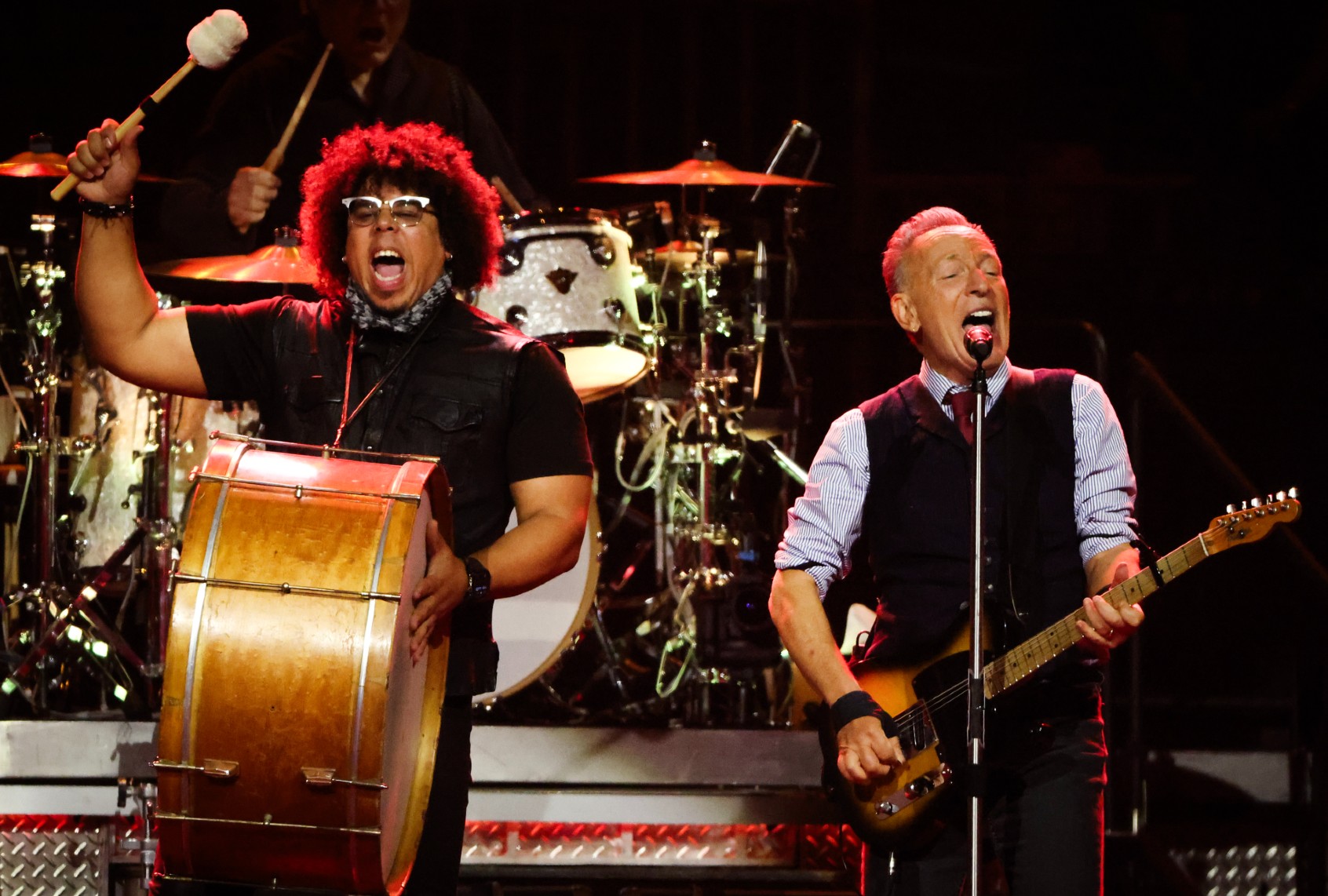
(Matthew J. Lee/The Boston Globe via Getty Images) Bruce Springsteen performs with the E Street Band at TD Garden
“Long Walk Home” is from 2008’s “Magic” album and is one of Springsteen’s best post-Reunion-era compositions. On previous tours, he would introduce it the same as he does right now: “This is a prayer for my country,” but by this point in the set, he doesn’t even need to do that anymore. The last verse of the song says it all: “You know that flag flying over the courthouse means certain things are set in stone / Who we are, what we’ll do and what we won’t.”
The heart of the evening comes at the midpoint; the entire band leaves the stage, and Springsteen stands at center mic with an acoustic guitar and offers “Land of A Thousand Guitars” from the “Letter To You” album. On the album, in that context, it was a song to forgotten friends and missing comrades. But in this set, what Springsteen is doing is talking about community. It is about the power of music and its ability to transcend differences and pull people together; it is about the reason everyone in this particular room is here right now to listen to these particular musicians. It represents a hope for what was, what still is, and what can be if we’re willing to fight for it.
“My City of Ruins,” the song he wrote for his beloved Asbury Park in the pre-gentrification days, takes on a larger role. This is the space for Springsteen’s longest speech of the night, where he runs through a list of individual transgressions on the part of the current administration, punctuated by “this is happening now.” He covers everything from the dismantling of USAID to the dismantling of the Voting Rights Act, a new addition to the list by the time the tour rolled into the Iron City last week. But what’s critical here is that this isn’t just a list of grievances, because he follows it with this gospel-influenced, deeply spiritual ode that is not just about Asbury Park but about any town in America that has been hollowed out by late-stage capitalism. “Rise up!” the chorus pleads, and demands, and hopes for.
The last song of the evening comes after an encore filled with Springsteen’s biggest hits, you get to hear “Dancing In The Dark” and “Born to Run” and sing along with 20,000 of your closest friends with the houselights on. Springsteen paces the front of the floor and the catwalk in the middle to tell “the story about the band,” as he’s described it many times before, most notably during his Super Bowl XLIII performance in 2009. You’d think that the night was done by the time he returns to the stage, soaking wet, having discarded the vest he wears over his white button-down shirt. He takes a seat at the front of the stage and this is the moment in a Bruce Springsteen concert where he will talk about a group that is doing work with hunger and food insecurity, usually a local food bank, offering them both a behind-the-scenes donation, a public service message in front of 20,000 people, and encouragement to drop money in the buckets the organization’s supporters will be holding in the lobby as you exit, a Springsteen tradition that has existed since the 1980s.
But then he offers, again, both a hope and a prayer, invoking Renee Good’s last words, quoting John Lewis, and urging the audience to get into “good trouble”: “Say something! Do something! Help! Sing something!” From there, he segues into the final number of the night, his cover of Bob Dylan’s “Chimes of Freedom,” which became part of the set in 1988, debuted the night that Springsteen and E Street were onstage in Stockholm, Sweden, for a live broadcast that went around the world, during which he announced his participation in the upcoming Amnesty International “Human Rights Now!” tour.
Dylanologists like to debate the true meaning and influences of “Chimes of Freedom” and while some of those aspects are behind Springsteen’s embrace of the cover, given the contexts under which he’s pulled it out — in 1988 and then in 2025 in Europe, the beginning of this current journey — it seems clear that what is drawing him to the song is its advocacy for the downtrodden, the forgotten, those who are suffering, those who need help, the bells are tolling in solidarity, in support, in recognition, and even in anger. It is a decision to end a concert with a song that is not your own (and isn’t something like, you know, “Twist & Shout”) but it is a tribute, a monument, a way of affirming lineage, and a rallying cry. It is both audacious and completely appropriate, but it is also a moment for the audience, it is a mountain top, it is a beacon of hope. And also? Invoking Dylan seems like Springsteen’s signifier as to how serious he believes this moment is.
Springsteen is doing his part in the resistance in his own way, and hopefully inspiring the people in the street and maybe some of his comrades in the arts. From a tour that, according to Springsteen, was not planned, it will be interesting to see what direction this propels him in next.
Read more
from music columnist Caryn Rose


