

Death is an elastic concept in all forms of fiction, but TV and film have mightily tested the limits to which our belief can be stretched. Even by those standards, the resurrection of the namesake heel of “Spartacus: House of Ashur” is quite the feat.
Our last glimpse of Nick E. Tarabay’s Ashur, a traitorous gladiator turned Roman toady, was of his beheading in the finale of 2012’s “Spartacus: Vengeance.” His executioner, Naevia (Cynthia Addai-Robinson), leaves no room to question his demise, hacking at Ashur’s neck three times before his melon rolls free from his torso.
A lot has happened in the intervening years, though. American culture has realigned dramatically enough for a significant percentage of the population to rally behind a sleepy, tacky would-be dictator. The illusion that anyone can be Caesar spurs the nation’s petty bourgeoisie to keep electing representatives who enact policies that siphon our tax money into billionaires’ coffers.
And “Spartacus” creator Steven S. DeKnight’s pulpy sword-and-sandals thriller, initially written off by critics as a tawdry circus of sex, filth and digital blood spurts, has since been reconsidered as progressive in its examination of class exploitation and gender politics.
There may be no better time for a schemer like Ashur to be resurrected from the underworld.
In a recent conversation with DeKnight and Tarabay, they clarified that our current political landscape had nothing to do with DeKnight’s or Starz’s decision to resume the gladiator franchise. DeKnight simply enjoyed working with Tarabay and was inspired by the possibilities of what might have been had Ashur somehow lived. So he pitched the story to the star and the cable channel a few years ago and began writing the first season in 2023.
“Anybody watching this show now who thinks that, oh, they’re commenting on what politically is going on now, it’s more of a coincidence than anything else,” DeKnight said, before conceding that the reigning motifs of “House of Ashur” also happen to align with our present anxieties.
(Starz) Nick E. Tarabay in “Spartacus: House of Ashur”
“One of the main themes of the original show was how the ultra-rich and powerful keep a slave class,” DeKnight observed. “In the United States and elsewhere in the world, it’s the same thing, except the slave class is the working class who can’t get ahead because the oligarchs are sucking up all the money.”
He continued, “Here you see the rich, powerful Roman elites who are above it all, making all these decisions that affect their people, and most of them do not care. So that’s the resonance. It’s a theme carried over from the original show.”
“Anybody watching this show now who thinks that, oh, they’re commenting on what politically is going on now, it’s more of a coincidence than anything else,” DeKnight said.
There’s a strong possibility — nay, probability — that a lot of you skipped the original incarnations of “Spartacus,” starting with the first season that bowed in 2010. “Spartacus: Blood and Sand” arrived smack in the middle of the most prestigious stretch of television’s modern Golden Age, when audiences swooned over “Breaking Bad” and “Mad Men.”
HBO had already spent a mint trying to seduce viewers with its glamorous vision of antiquity. But in a world supposedly clamoring for more shows like “Rome,” DeKnight served up a more popularly appealing vision; critics wrote it off as a small-screen aspirant to succeed “300.” Except it wasn’t really that.
While the show borrows a few stylistic elements from Zack Snyder’s bombastic beefcake extravaganza, namely its penchant for roaring slow-motion swordplay sequences and conspicuously fake digital blood spurts, the movie was never brave enough to depict any of its characters lustily singing, “my c—k rages on, my c—k rages on.”
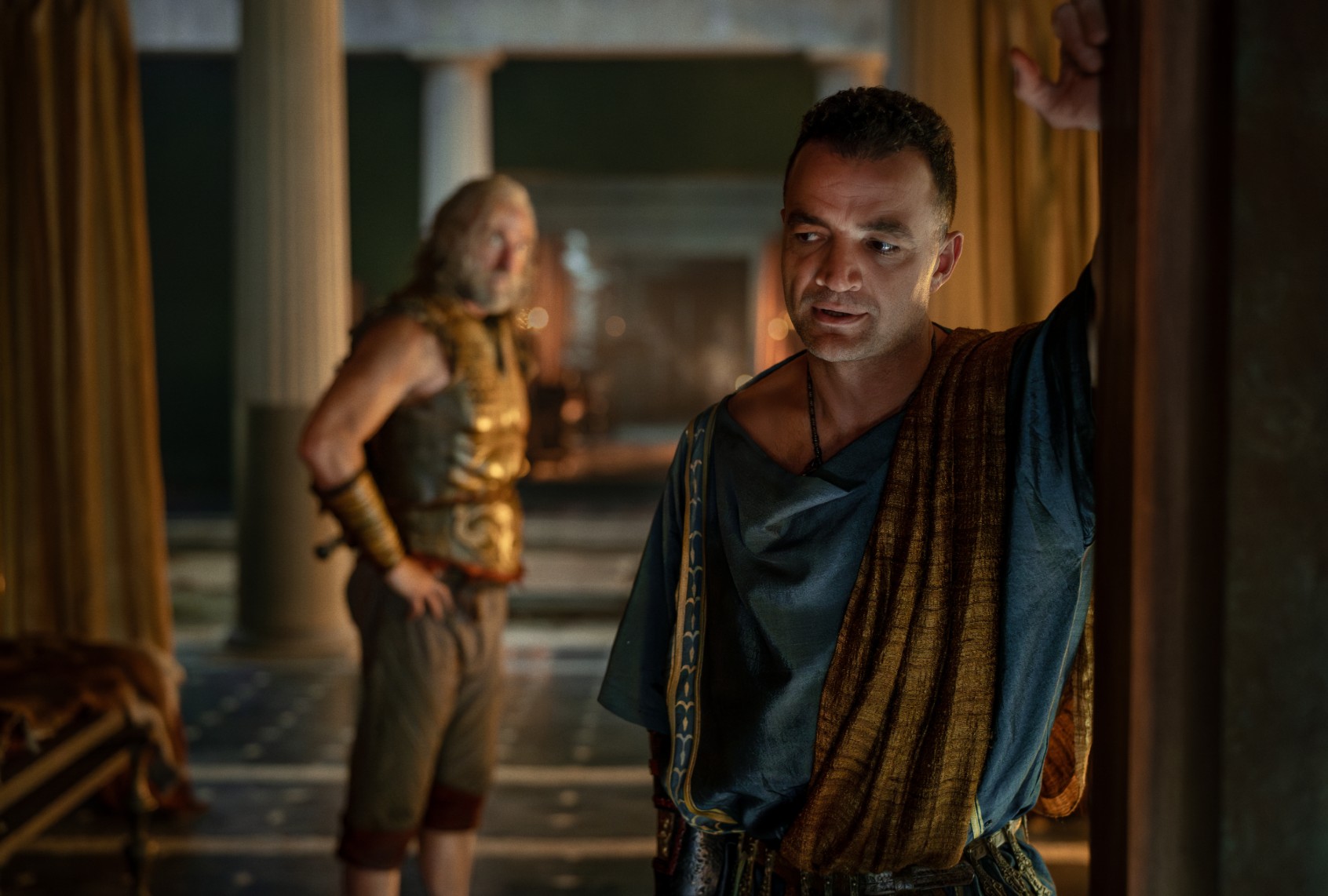
(Starz) Graham McTavish and Nick E. Tarabay in “Spartacus: House of Ashur”
Out of context, that quote may lend weight to the strain of snobbery that wrote off “Blood and Sand” before the plot found its footing, which it did after its introductory episodes. What secured the show’s passionate fandom are the scripts’ provocative considerations of classism and cultural discrimination as the most potent accelerants of any society’s downfall.
Ashur, then, is the consummate outsider. His fellow gladiators never accept him, so he turns on them. The Romans look down on him, even as he does their bidding. He’s also a rapist, assaulting not only Naevia but his former domina, Lucretia (Lucy Lawless, who makes a brief appearance to introduce the season).
DeKnight is open about denying Ashur a retcon that erases his past crimes. Instead, his task is to use this mystical second chance to be a better person. “The problem is the Roman elites keep dragging him back down, so he has to go back to his old ways,” he said.
It probably goes without saying that Tarabay has much more sympathy for his character than anyone else. “I always thought Ashur is just a great fella,” he shared with a sly smile, “and I never perceived him as a villain or a bad guy. I always perceived him as a very smart guy, ahead of his time. That’s why he is who he is.”
“House of Ashur” comes to us as the right wing lovingly clutches a fantasy of ancient Rome heavily influenced by Hollywood as something to which America should aspire. However, by picking up the action shortly after the end of the Third Servile War, DeKnight and his writers return Ashur to life just in time to see the Roman Republic begin to crumble.
“House of Ashur” comes to us as the right wing lovingly clutches a fantasy of ancient Rome heavily influenced by Hollywood as something to which America should aspire.
DeKnight likens America’s cyclical fascination with ancient Rome to our nostalgia for the 1950s.
“Do you really want to live in those time periods, especially when you go all the way back to ancient Rome?” DeKnight asks. “Well, the answer is no.”
To underscore that point, Tarabay heartily interjects here with, “HELL no!”
“It’s a very brutal, short lifespan. Life was cheap,” DeKnight adds, “ And I think the romanticizing about Rome, and particularly the Roman Empire — we’re in the Republic stages now that a lot of people forget, and the Republic stages were pretty damn good.
“Then some very powerful, greedy people destroyed the Republic,” he concluded, “which is a good cautionary tale.”
Ashur, being a Syrian and former slave who has been elevated to the status of dominus of the Capuan house that once held him in bondage, has many of an insider’s benefits minus the privilege of being Roman-born. Raising his house’s reputation as a formidable gladiator stable is the only path he can see to being accepted into society’s highest echelon.
Want more from culture than just the latest trend? The Swell highlights art made to last.Sign up here
Capua’s inner circle sees no reason to give Ashur’s fighters standing in the local arena until he offers them a diversion they’ve never seen before: a capable, deadly gladiatrix he renames Achillia, Goddess of Death (Tenika Davis). Anyone can see that Ashur and his new acquisition have much in common; she’s from the northwest African kingdom of Numidia, which the Romans view as a barbaric wasteland, much in the way they see Syria. But Ashur sees her and the rest of his gladiators as property, believing his wealth and diplomatic acumen can one day buy him a seat at the table of Rome’s most powerful.
All this may turn out to be the tortured dream of a long-gone spirit or an alternate reality traveled to teach a damned soul a lesson about the choice he made in another life, one that ends with his inglorious death. Either way, thousands of men and women who defied their enslavers are crucified on the road leading to Rome’s gates, which only strengthens the public’s resolve to bend the knee to the strongman who comes out on top.
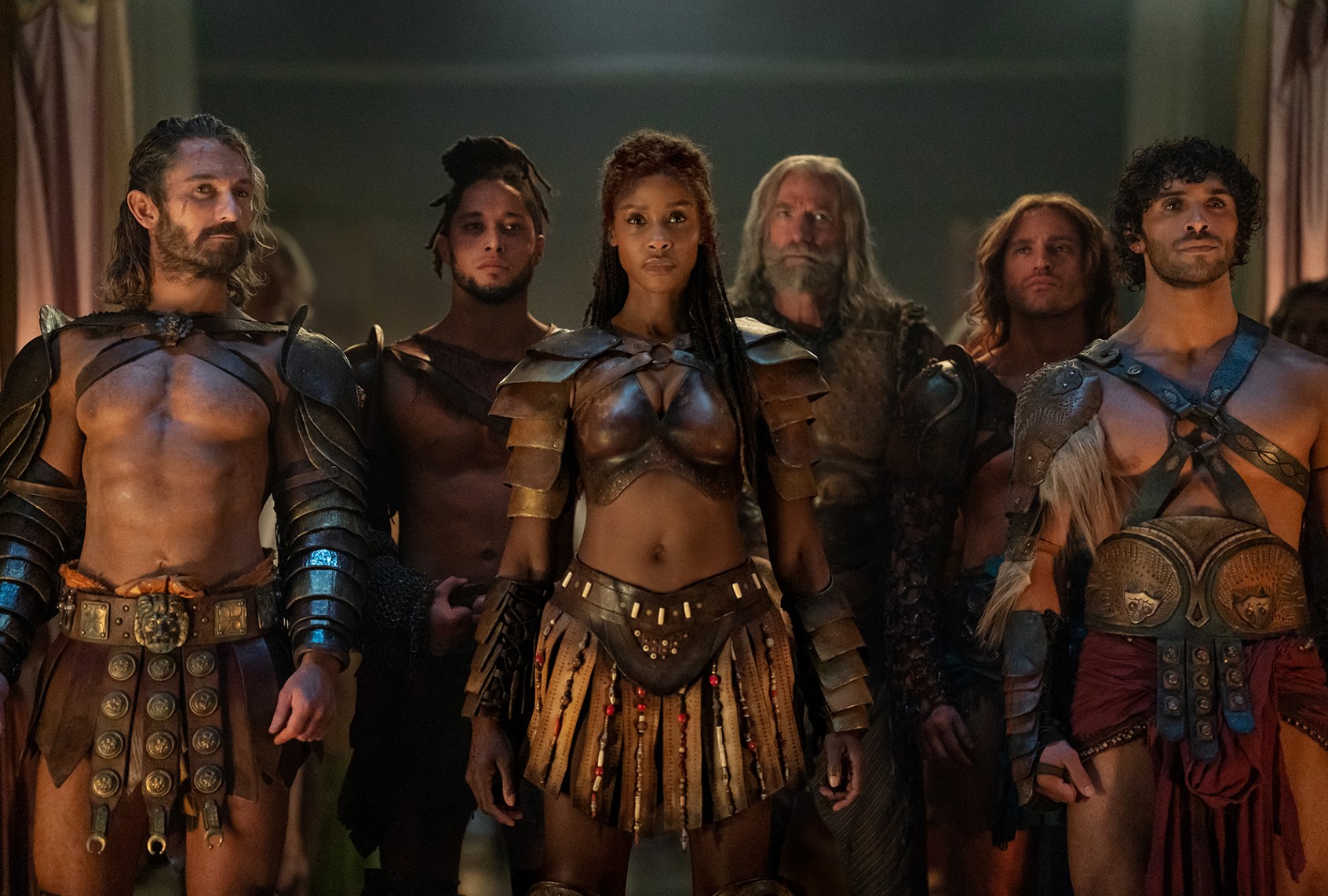
(Starz) Dan Hamill, Evander Brown, Tenika Davis, Graham McTavish and Jordi Webber in “Spartacus: House of Ashur”
With that as the framework from which “House of Ashur” operates, Tarabay understands the eternal allure of the gladiator as opposed to the serpentine psychological maneuvering of Roman senators. “I always see it as you know where the enemy is. It’s very clear: I’m fighting you, you’re fighting me,” he said. “There’s a base, kind of primal feeling to it, and I think that’s what people like about it. It’s down to business, you know? Especially in the arena, there’s no political stuff. It’s right there.”
That’s probably why we keep buying return tickets to these spectacles, and that’s fine — so long as we also heed their lesson of leaving the supposed glory of ancient times in the long-gone past where it belongs.
“Spartacus: House of Ashur” streams 9 p.m. Fridays on Starz, with new episodes streaming weekly on the Starz app and on-demand platforms. All previous seasons of “Spartacus” are available to stream on Netflix and the Starz app.
Read more
about America and ancient Rome


