

People are unreliable. Whether they intend to or not, even the best of them let you down sooner or later because they are only human. Just like you.
Know who you can generally count on in this world? Your favorite folks on your favorite television shows.
Good TV is the product of many hands working harmoniously to merge visuals, writing and performance into stories that breathe, laugh and ache along with you. Great TV imbues its fiction with a soul, coaxing us to view fully crafted characters as beings of flesh and blood, or constructed unscripted scenarios as truth.
Relationships power television, is what I’m saying. If that weren’t true, ‘shipping wouldn’t be a global pastime. Even on shows where the core relationships are entirely platonic, we connect with some part of the duos or ensembles that keep us watching them – whether that’s because their friendships remind us of something or someone in our lives, or they model an ideal for us to aspire to.
So, with half the year behind us, here are seven TV friendships, partnerships, support networks and buddies who renewed our faith in our fellow humans each time we hung out with them, whether in 30-minute increments or for hours.
Selections are arranged alphabetically by series title.
Dunk (Peter Claffey) and Egg (Dexter Sol Ansell), “A Knight of the Seven Kingdoms” (HBO)
(Steffan Hill/HBO ) Peter Claffey and Dexter Sol Ansell in “A Knight of the Seven Kingdoms”
One was born into the most powerful family in Westeros and raised in luxury. The other, a Flea Bottom orphan taken in by a drunken hedge knight, spent most of his life sleeping on the hard ground. But when Ser Duncan the Tall crosses paths with a slender, small boy calling himself Egg, so begins a friendship that will one day change the Seven Kingdoms. (Or is it Nine Kingdoms?)
In a universe where betrayal is a common currency, the bond that develops between Dunk and Egg is absolutely magical, although not entirely wrought from thin air. Egg, who is revealed to be Prince Aegon V Targaryen, has never known brotherly love or witnessed goodness in action until he meets Dunk, one of the lowest of the lowborn. Salon’s Nicolas Liu said it best in his analysis of the show: “Duncan the Tall walks knowing what it is like to be small, hungry, and powerless, but also unburdened by the pragmatism and vanity of power and wealth, which so often buries a noble’s sense of morality and love.”
To Dunk, Egg isn’t the weak prey his brothers tauntingly tell him he is, or some delicate bauble, but a friend who can take a good-natured ribbing, who encourages boldness and deserves to be cared for. Dunk and Egg’s odd couple adventures provide six too-brief episodes of respite and hope at a time when both are in short supply. That alone makes it a comfort watch.
Siegfried Farnon (Samuel West) and Mrs. Hall (Anna Madeley), “All Creatures Great and Small” (PBS)
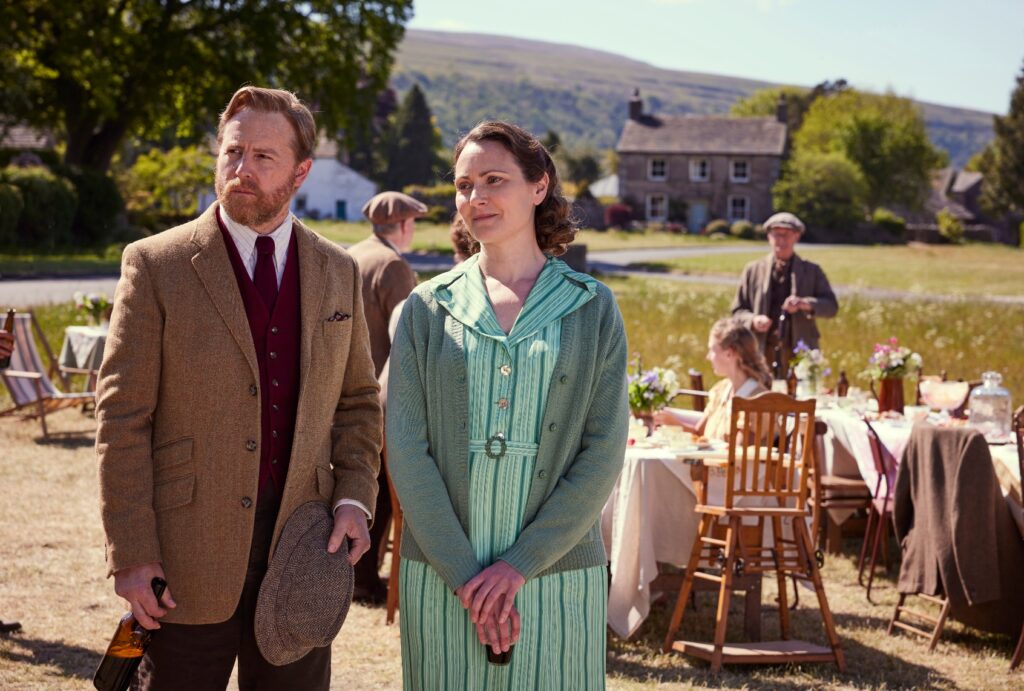
(Helen Williams) Siegfried Farnon (Samuel West), Mrs. Hall (Anna Madeley) on “All Creatures Great and Small”
Blurred boundaries between work and personal lives are inevitable when a person’s workplace and home are one and the same. For many seasons, the most recent of which take place during World War II, that’s how Siegfried Farnon’s veterinary practice operates, with Siegfried sharing his home with his junior partner James Herriot (Nicholas Ralph) and Mrs. Hall, a loyal and resourceful housekeeper who often finds herself taking on unpaid emotional labor.
So when Season 6 opens in 1945 and shows that Mrs. Hall has moved out to live with her son and his new wife, you can’t help feeling happy for her. (Ditto for James, who moves his wife Helen (Rachel Joy Shenton) and their son and daughter off to Helen’s family farm.) But Siegfried’s life falls apart so completely that Mrs. Hall must come to the rescue. Despite how frustrating this sounds, the series develops the relationship between these two in such a way that Mrs. Hall’s return to Skeldale House is a balm for both. She keeps Siegfried human, and he makes her see and feel her value not only to his household but also to the community that his practice serves.
Ardent “All Creatures” viewers like to ‘ship these two, but I prefer their bond to remain platonic. They are war buddies in the best sense, in that they both served in World War I and, in 1945, recognize the importance of keeping the hearth fires sparked to light the way back for all lost souls, including the ones that already returned from the front.
Reggie Dinkins (Tracy Morgan) and Arthur Tobin (Daniel Radcliffe), “The Fall and Rise of Reggie Dinkins” (NBC)
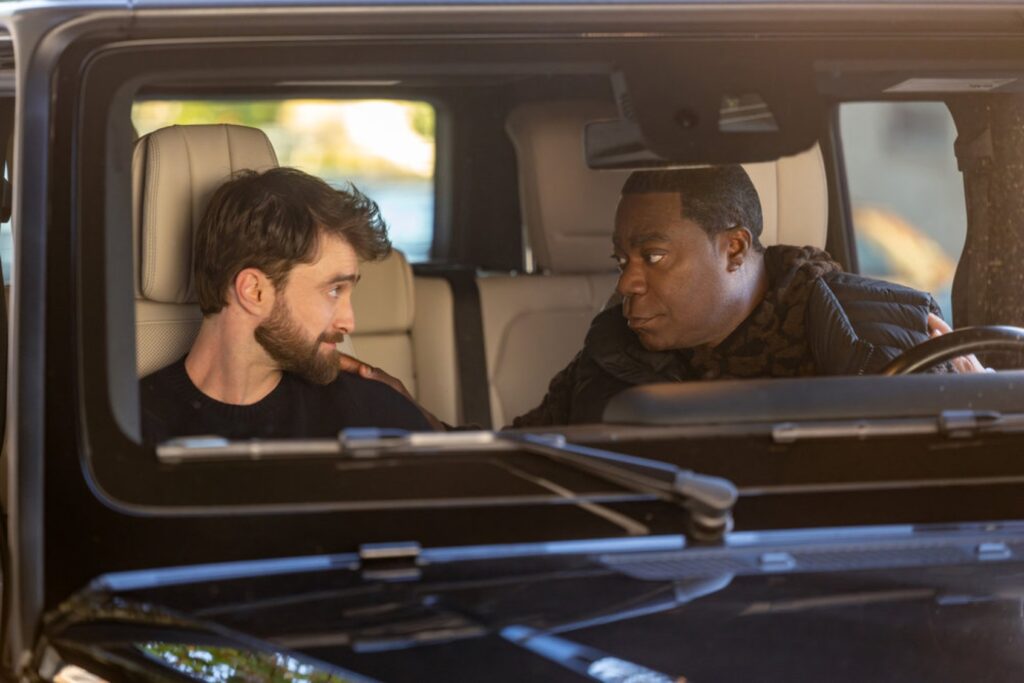
(Scott Gries/NBC) Daniel Radcliffe and Tracy Morgan in “The Fall and Rise of Reggie Dinkins”
Before this, I had next to no reason to believe that Radcliffe and Morgan would work as a comedy team of any kind. Sure, Radcliffe has amply proven his comedic chops in shows like “Miracle Workers” and “Weird: The Al Yankovic Story,” an excellent feature-length, extremely fictionalized biopic in which Radcliffe doesn’t just commit to the bit; he puts it in a headlock. Most know Morgan as a singular kind of clown who pulls everyone’s focus simply by entering a room. It takes equally broad, fierce personalities to match his energy.
Much to my surprise, Radcliffe more than steps up as a down-and-out documentarian inserted into the life of a disgraced football star grasping for a comeback. Every member of this cast holds their own, granted, but Morgan and Radcliffe’s onscreen give-and-take earns Arthur’s slow, steady acceptance into Reggie’s weird, lovely family dynamic. (One held together by Erika Alexander’s outstanding performance as Reggie’s ex-wife and devoted manager, Monica, I should add.) Arthur’s season-ending announcement that the months they’ve spent together only mark the start of his project might make you a little giddy to see how far and high this partnership will soar.

(Courtesy of HBO Max) Hannah Einbinder and Jean Smart in “Hacks”
Over five seasons, Deborah and Ava constantly redefined the parameters of what each owed to the other. What started as purely professional, with a seasoned veteran taking a dismissed but talented upstart under her wing, quickly got personal as Ava betrayed Deborah’s confidence, and Deborah sued Ava while keeping her in her employ. But like any lasting marriage, all appearances of rancor and hatred masked hurt and insecurity on both sides until, in their final push, they unite to take on the men who would see them fail.
The way “Hacks” balances professional wish fulfillment with the cold reality of show business won’t soon be matched by another series, if it ever happens at all. But the hard-won love between these two women, the kind that’s strong enough to give an exhausted Deborah a reason to keep living, is the stuff of great movie romances – down to the picture-perfect season finale set to the melody of a Barbra Streisand-Judy Garland duet.
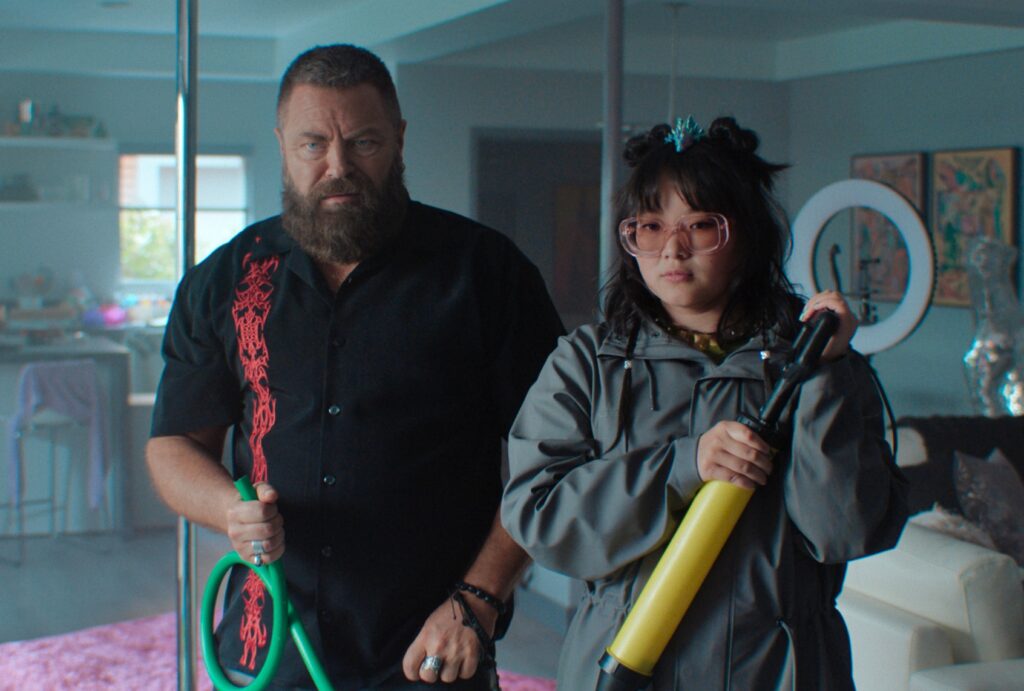
(Apple TV) Nick Offerman and Thaddea Graham in “Margo’s Got Money Troubles.’
You’ve heard the old advice to never meet your heroes, right? Some scenarios prove that to be wrong. Susie, a diehard cosplayer, is the only confidante and roommate to stand by Elle Fanning’s Margo after she gets knocked up by one of her college instructors. Susie also worships Jinx, a wrestling legend who happens to be Margo’s father – although Margo withholds that bombshell until Jinx shows up at the door of their shared apartment, having emerged from rehab with no place to go.
As Margo constructs a secret OnlyFans persona to make money, only Jinx and Susie understand what she’s doing without judging her. And as the three team up to sell Margo’s fantasy to the horny online masses, Susie gradually becomes a second daughter to Jinx, which makes it especially heartbreaking when he relapses and nearly dies of an overdose. In a scene near the end of the season, after he’s apologized to his relatives, he makes amends with Susie, one-on-one. Watching Graham break into tears and whisper, “You really scared me,” is one of the most vulnerable moments I’ve witnessed in the last six months. It pulls a hero Susie worshipped as an idea off his pedestal and into her embrace, in all his wounded imperfection, and shows him simply as an man who’s injured and down for the count, but recovering.
Want more from culture than just the latest trend? The Swell highlights art made to last.Sign up here
Dr. Paul Rhoades (Harrison Ford) and his caring community, “Shrinking” (Apple TV)
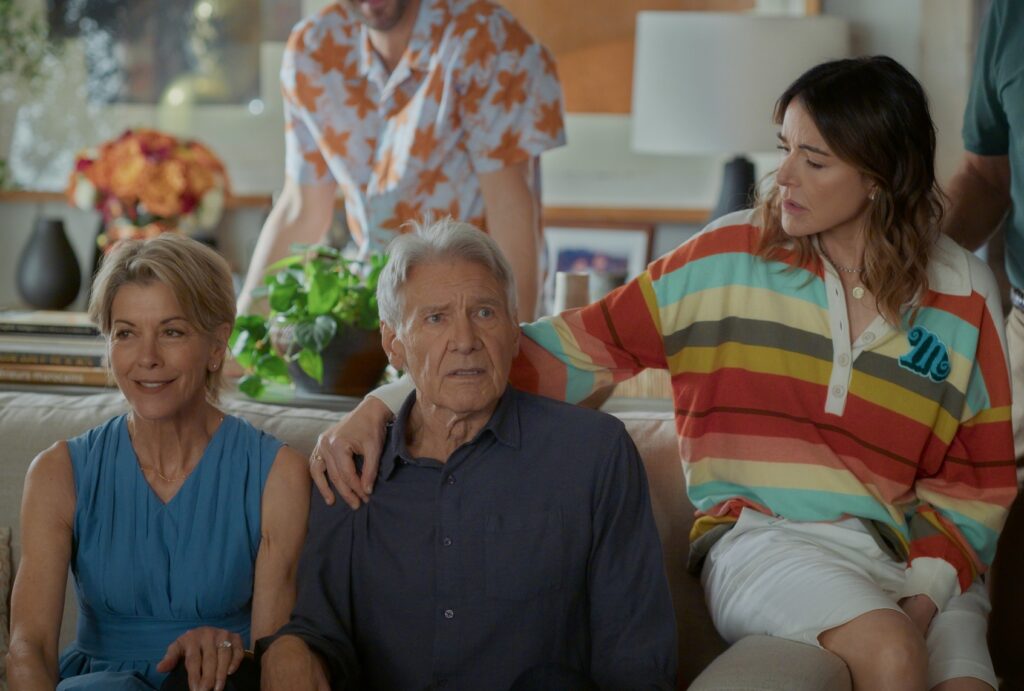
(Apple TV) Wendie Malick, Harrison Ford and Christa Miller in “Shrinking.”
A show that launched with an improbable dynamic between Jason Segel’s too-involved therapist Jimmy Laird and his patients, as well as his coworkers Gaby Evans (Jessica Williams) and Ford’s Paul, has since earned our trust, if not our total acceptance, in how Jimmy and the rest work and live together. When “Shrinking” at one point pivots around a subplot involving Jimmy and his daughter Alice (Lukita Maxwell) befriending the man responsible for his wife’s death, some suspension of disbelief is a worthy trade to watch a portrayal of mercy and healing play out with such agony and, eventually, soulfulness.
But the true test of how far Jimmy and his close-knit circle of pals and neighbors are willing to go happens in the recently completed third season: Paul’s Parkinson’s disease progresses to a point that he has to confront the reality of relinquishing his old life. In doing so, he sets an example for everyone around him – including Jimmy, whose abandonment issues surface.
It is not hyperbole to say that Ford turns in the performance of his career, assisted by Michael J. Fox’s guest star appearances and the sensitive work of his castmates. By the end of the season, I reflexively shouted along with Paul’s signature sign-off to every interaction: “F**k Parkinson’s.”
Rob Rausch and Ron Funches, “The Traitors” (Peacock)
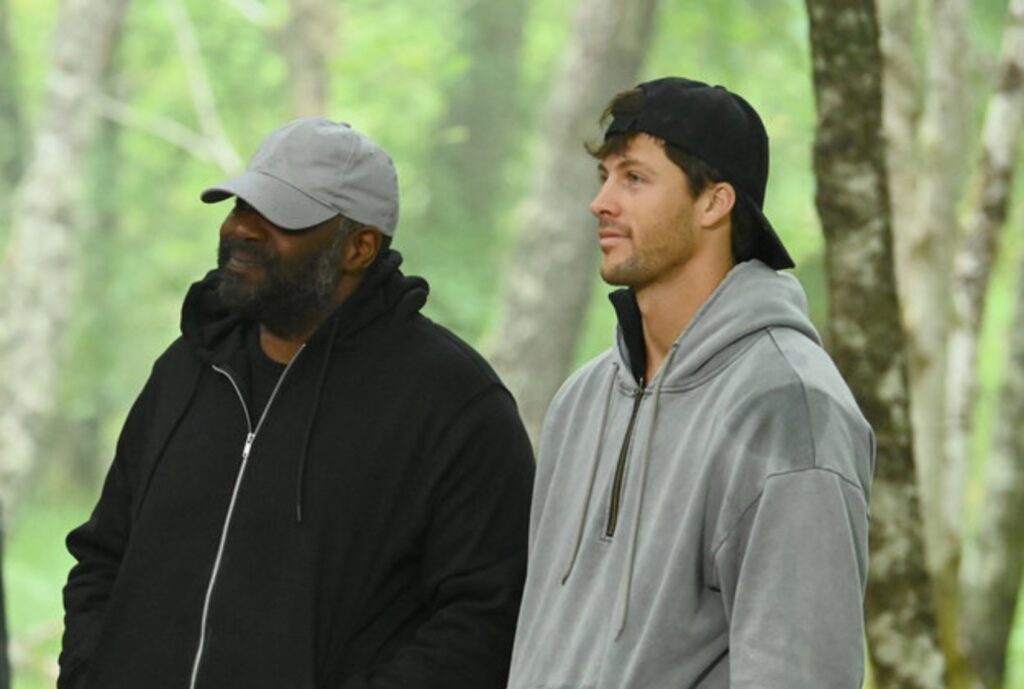
(Euan Cherry/Peacock) Ron Funches and Rob Rausch on “Traitors.”
Fun as it is to watch, there’s no refuting how psychologically sadistic “The Traitors” can be. This is a show that pits real people against each other by requiring them to build friendships and trust while empowering a few to sow doubt and dissent by lying through their teeth.
As “Love Island” alumnus Rob Rausch frequently reminded us and himself, whatever deceptions he committed were all part of playing a game. But when the inevitably cutthroat social dynamics of in-groups and out-groups lead the other players to turn on comedian Ron Funches, not even the ice-blooded Rausch can live with himself. Although it endangers his secret Traitor identity, he tries to protect Funches. But unfortunately, by the time Rausch steps up to defend him, the innocent comic is beyond any chance of clemency at the banishment round table.
Inevitable as Funches’ dismissal was, witnessing the quiet camaraderie blossom between him and Rausch was one of the kindest, warmest subplots of an especially ruthless season. “I mean, sometimes the loneliest place for someone like that is in a crowded room,” Rausch observes in recognizing the sensitivity of a fellow introvert.
Funches, who went on to be diagnosed as neurodivergent after he watched the show with the rest of us, praised Rausch’s humanity amid a nearly impossible situation. Some of us watching at home, meanwhile, felt a twinge of optimism at seeing a real person shake off his reality TV performance and prove that, actually, sometimes people do go to competitions like this to make friends.
Read more
about the worthwhile shows that didn’t make this list


