

Early in his extraordinary new documentary, “Remake,” seasoned filmmaker Ross McElwee reminisces with his young son, Adrian, about their travels together, presenting McElwee’s films at various festivals around the world. “What’s your favorite place that we’ve been to, Adrian?” McElwee asks his son in the archival footage. Adrian recalls a snafu from the Munich Film Festival, but can’t quite remember the details. McElwee explains that the numbers on his film reels were mislabeled, causing extended confusion as they tried to put the footage back in the correct, chronological order. Still a child, Adrian looks off into the distance, biting his gelato spoon while registering the information.
Then the footage burns out, replaced by shots of Adrian across his youth, preserved in celluloid amber: raking leaves on an autumn afternoon, waving a sparkler around in the summertime, looking at himself in the mirror as a baby. McElwee’s voice, more mature and stoic than before, fades in. “The story I thought I was telling with my filmmaking, the stories of lives lived over decades, is now disjointed, confused — the reels are all out of order,” he says. “First there is a father, and he has a son: me. But then it starts all over. I am now father, and I have a son: you. But something goes awry. Something goes off-script. And then, suddenly, you’re gone.”
“Remake” is McElwee’s first film in 15 years, appearing like a jewel out of a mountain of life’s rubble. His extended absence from filmmaking was necessitated by Adrian’s death in 2016 and the monumental torrent of confusion and emotional displacement that followed. McElwee’s last documentary, 2011’s “Photographic Memory,” saw Adrian as a young adult, trying to come into his own and figure out his place in life amid a shifting social landscape riddled with digital black holes.
(Music Box Films) Adrian McElwee in “Remake”
McElwee stitches together the past and present to find new meaning in their seams, a jagged line that runs through time and points toward the future. To call his latest film a contemporary masterwork would be true, but there’s also no quantifying the magic McElwee conjures here, no comparing it to anything else.
In that film, McElwee set out to reconcile his somewhat fractured relationship with Adrian, who’d become distant and disillusioned compared to his spritely, curious youth, by traveling back to France, where he worked as a photographer’s assistant in his early 20s. In retracing his steps, McElwee sought to understand Adrian better, to comprehend the grasp digital media had on his son in contrast to his own fascination with the analog film camera he frequently used to capture his family, both for his own memories and for his documentaries. In “Remake,” McElwee laments the hope that making “Photographic Memory” gave him, an aspiration that he was depicting his son on the cusp of finding his way through the dark. “The film might’ve been shot as a documentary,” McElwee says, “but now it’s fiction.”
“Remake” may be the story and study of a tragedy. But McElwee’s nonlinear construction and brusque, confessional narration slowly transform the film into something much deeper, a poignant work of art that instantly yet subtly aligns itself with the great stories of our time. His mission is unassuming. This is a film McElwee feels compelled to make, as if it were something living inside of him that had to be excised by any means necessary.
Like all grieving, it is complicated and disordered, and beautifully so. McElwee stitches together the past and present to find new meaning in their seams, a jagged line that runs through time and points toward the future. To call his latest film a contemporary masterwork would be true, but there’s also no quantifying the magic McElwee conjures here, no comparing it to anything else. “Remake” is a truly singular piece of art, a self-reflexive rumination on life and the result of all its passions. It is memory embodied.
Sometime in the 2010s, McElwee received a call from director and producer Steve Carr, who wanted to explore remaking his breakthrough documentary, 1986’s “Sherman’s March,” into a narrative film. “Sherman’s March” loosely explored McElwee’s hapless search for love during a trip to his native South, where he planned on making a film about a Civil War campaign through the area. Along the way, the movie became less about American history and more about McElwee’s family and his experiences with religion and relationships.
Carr, the director of fun-for-the-whole-family crowdpleasers like “Daddy Day Care” and “Paul Blart: Mall Cop,” didn’t exactly seem like the best candidate to take on something as intricate as “Sherman’s March.” But at the time, a teenage Adrian, hoping to break into the more commercial side of the film business, was vexed by his father’s reluctance to pursue Hollywood money-makers. So, in hopes that a remake might bring the two of them together in some way, McElwee signed the rights to “Sherman’s March” over to Carr, with a condition: McElwee would be granted access to produce a making-of documentary about the new film. McElwee set up his camera to film himself the day he signed the contract. He preferred an easygoing static tripod shot — a point Adrian contested, as is shown in the film. After some back and forth, McElwee relented, letting Adrian try his slow zooms and dynamic shots. The final product in “Remake” is a combination of the two styles, with the loving squabble between a father and his son left in the middle.
Want more from culture than just the latest trend? The Swell highlights art made to last.Sign up here
“Remake” is often startingly honest in this way. McElwee refuses to scrub the truth from his personal histories, choosing instead to confront his own regrets head-on. His regret lingers alongside his grief, allowing the viewer to understand his complex feelings of remorse. Occasionally, McElwee will verbalize his paternal contrition. But most of the time, his choices in archival footage do the talking, asking silent questions. Was he too hard on his son? Did he push him in the wrong direction by trying to reorient his path? Did the fun of the film festival circuit eventually become a blinding limelight, through which Adrian couldn’t see past as he got older? None of these questions have answers. Still, McElwee seeks meaning that may be embedded somewhere in the film grain, revisiting the footage he compiled during the documentary for a remake that never came to fruition, and measuring its tenor against his finished films.
In the process, McElwee creates a patchwork tapestry, comprised of vignettes across time. This one heartwarming, that one agonizing. Together, they form a rich yet incomplete portrait of an existence cut short, which McElwee hopes to broaden by weaving in meaning from before and after Adrian’s life, all captured by McElwee’s omnipresent camera.
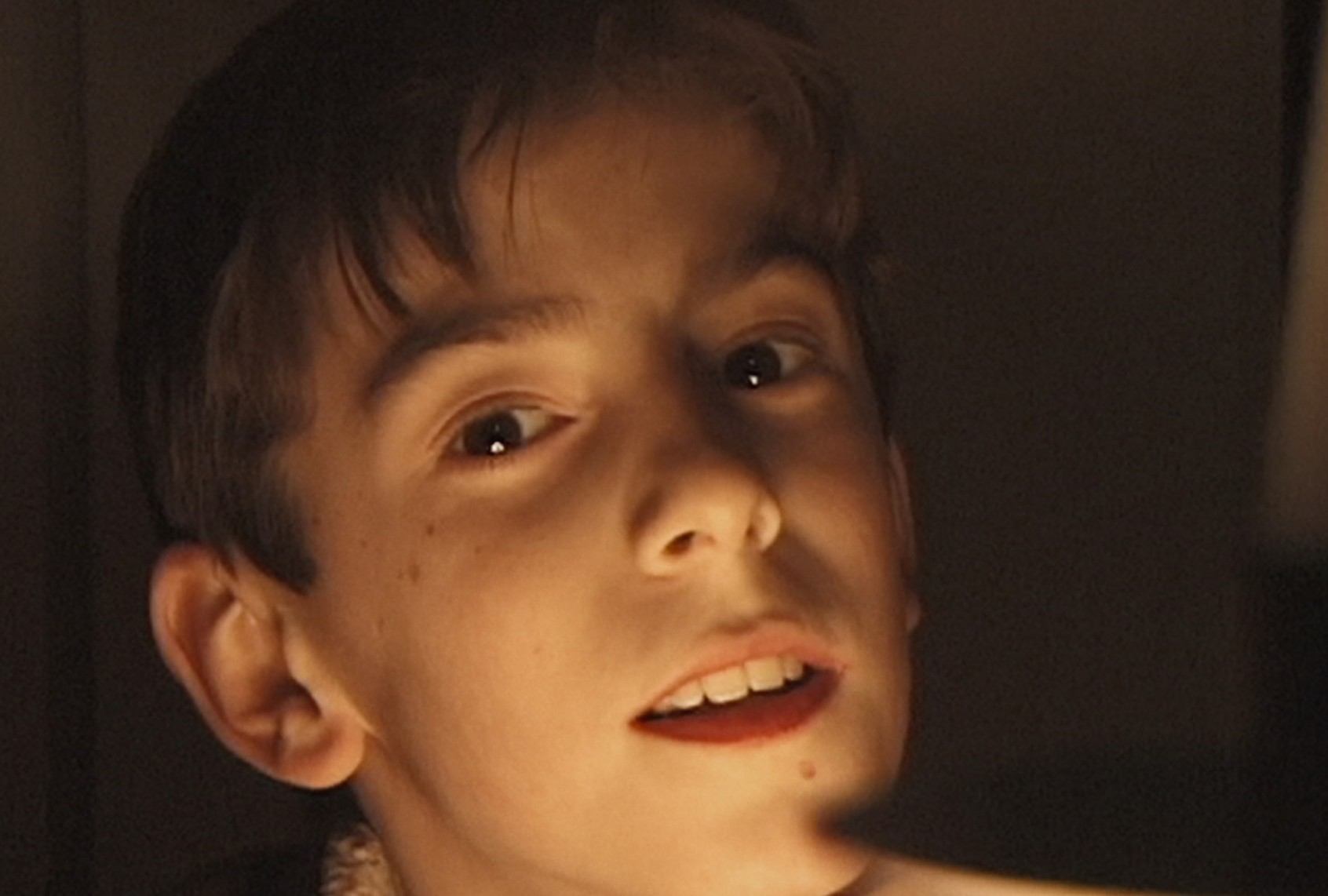
(Music Box Films) Adrian McElwee in “Remake”
But even that begins to feel disingenuous. There’s an elephant in the room in every scene, and its lens follows the subject everywhere. “Remake” stars McElwee, his son and the camera — that one simple tool that connects Adrian and his father through space and time, life and death. What forged McElwee’s passion and helped him establish his life’s work now reveals its dual nature as the wedge that kept him and Adrian apart. For McElwee, the revelation presents a new crisis. Was he so concerned with capturing his son’s malaise as Adrian became an adult that he missed details he might’ve seen if one eye weren’t looking through the viewfinder? Set against the backdrop of our modern culture, where we’re filming everything but listening to no one, McElwee finds himself trapped in irony’s clutches. In his desire to portray Adrian’s immersion in parasocial worlds filled with shadowy, destructive figures, McElwee’s own perspective was equally one-sided.
Of course, this is a film about life, and nothing in life is ever so simple. Alongside his regret, McElwee wears compassion for himself and even more for his son, bravely journeying into Adrian’s own archives, including footage from a film Adrian was making about his addiction and recovery. McElwee finds images both startling and serene; videos that fill in gaps he couldn’t on his own. He lovingly omits most graphic footage, but commits to approaching his and Adrian’s shared story from a different viewpoint — a remake.
“Remake” stars McElwee, his son and the camera — that one simple tool that connects Adrian and his father through life and death. For McElwee, the revelation presents a new crisis. Was he so concerned with capturing his son’s malaise that he missed details he might’ve seen if one eye weren’t looking through the viewfinder?
Throughout the film, alongside the contemplation on the sacrifices he’s made for his work, McElwee repeatedly revisits the importance of filmmaking from different angles: as a tool for preservation, for storytelling, for survival. A film, especially a documentary film, can often tell the story of our lives more succinctly than we ever could. It can also distort that same story into something untruthful. It’s both fact and fiction, and the meaning changes depending on your vantage point.
This idea got me thinking about a class I took in college about ethnographic filmmaking, after an extended break from school following some of my own issues that took me off-track and made my life listless. Searching for direction, I found guidance in professor and documentary filmmaker Carolyn Strachan, whose average RateMyProfessor score hovered somewhere around 2.1. She was a stickler for analysis, whose intensive assignments were the bane of many classmates. But her thorough coursework and off-the-beaten-path syllabus of films opened my eyes to countless new ideas and perspectives. Her class reignited my passion for both writing and film, and pushed me back toward a version of myself that I recognized.
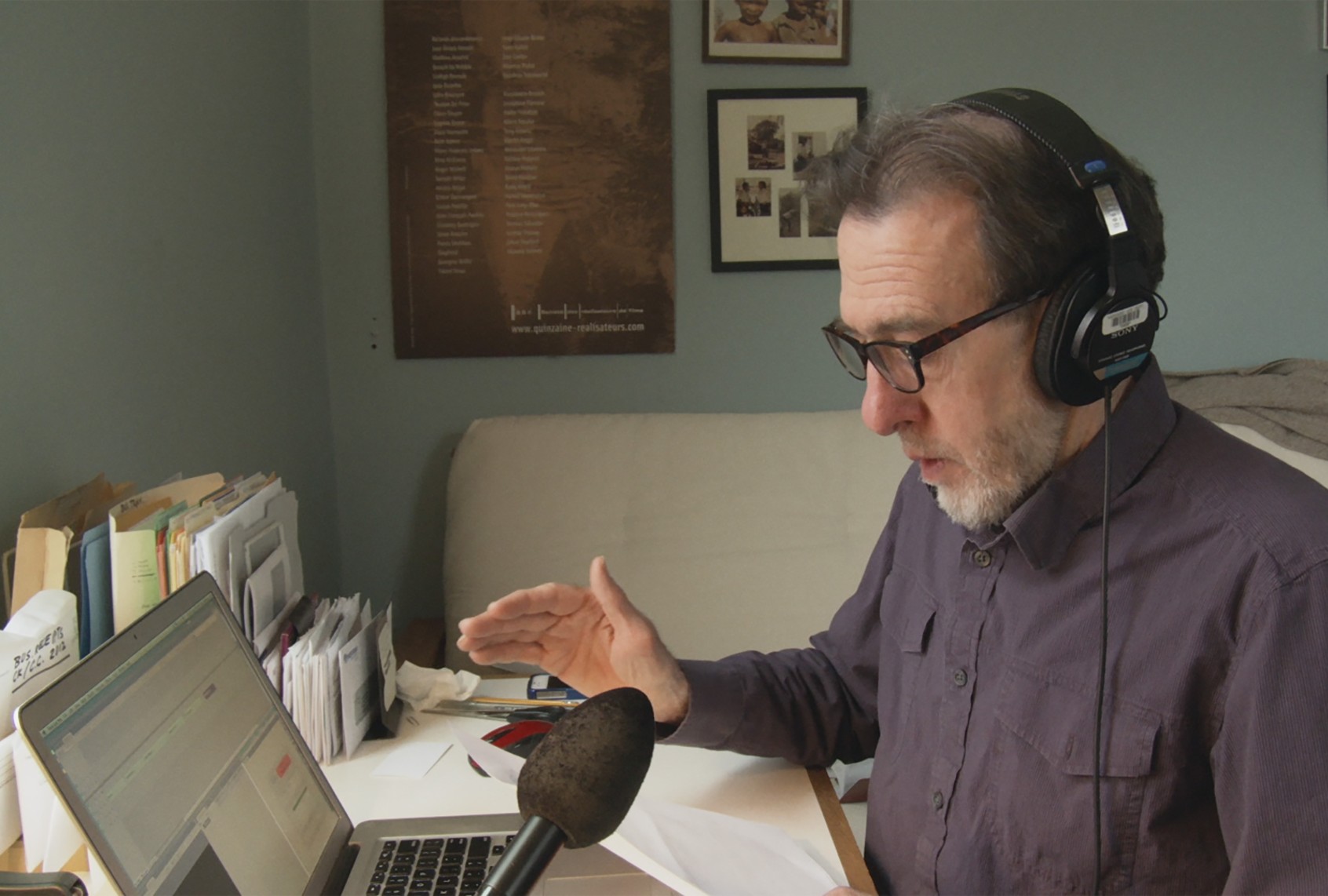
(Music Box Films) Ross McElwee in “Remake”
It took some time to realize how fundamental this course was. But when I understood the connection last year, I tried to get in touch with Professor Strachan to thank her, only to find out that, in 2022, she died after a long battle with cancer. It was a personal matter that never came up in class, but almost certainly influenced her passion for her work and her teaching. Immediately, I thought of how many of my peers complained that her assignments were too difficult, and her film choices were too unconventional to analyze easily, even for college-level writers. She wanted too much from us, they thought. Now I see that she simply wanted us to work a little harder to see how truly beautiful and varied life can be.
I was upset that I’d never be able to thank her, to laud her for pushing students out of their comfort zones by showing them documentaries that were not easily palatable. There was nowhere to put my grief. So, I’m putting some of it here. As McElwee’s film reminded me, there’s no easy way of making sense of life. But art is our foremost way of working through it, of trying to understand who we are, who we become and how. There’s no better way to honor someone than through art, even if it’s imperfect, even if it can’t reflect their substantial impact, no matter how brief.
Shortly after he and Adrian reminisce about the mishap in Munich, McElwee continues his narration. “So, yes, you’re gone,” he says. “But you’re not gone, not entirely. Because I still have all these moments with you I captured on film.”
Read more
about documentaries that will stay with you


